Thursday, April 8, 2021

American Cinematography Magazine / Game On: Game-Engine Technology Expands Filmmaking Horizons / August 14, 2020 / Noah Kadner

https://ascmag.com/articles/game-on-game-engine-technology

American Cinematography Magazine / Game On: Game-Engine Technology Expands Filmmaking Horizons / August 14, 2020 / Noah Kadner 

--reposted--

“What directors want are iterations. They want to find all the possible challenges early, so the faster you can see a result, understand the issues and create another iteration, the better. Real-time engines make that process happen instantly. It’s just like playing a video game.”
https://cms-assets.theasc.com/Game-On-1_TTF_PATHFINDER_TR_01_PNG-copy.jpg?mtime=20200814090957

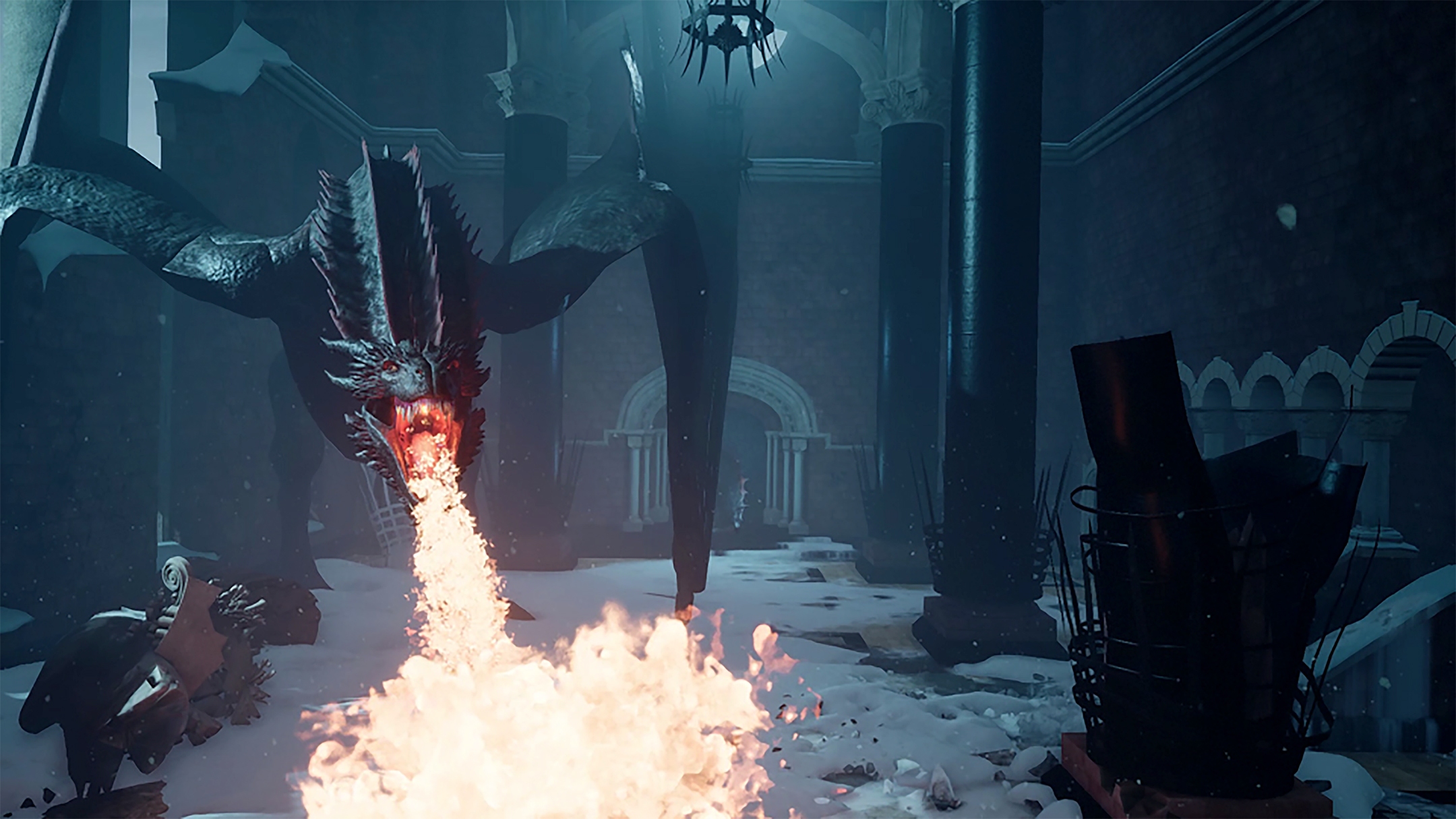
At top, for Season 8 of HBO’s Game of Thrones, The Third Floor offered real-time rendering during production — which, for example, helped represent a dragon (pictured here) as shots were composed, framed and performed. The company also provided virtual versions of story locations for preproduction “scouting.”

The Mandalorian image by François Duhamel, SMPSP, courtesy of Lucasfilm Ltd. Cine Tracer image courtesy of Matt Workman/LED volume photo by Mike Seymour. The Lion King unit photography by Michael Legato, courtesy of Disney Enterprises, Inc. Game of Thrones image courtesy of HBO and The Third Floor, Inc.

Game engines such as Unreal Engine and Unity were, as their umbrella term implies, originally designed for the development of real-time applications, aka video games. In recent years, advances in both hardware and software have ushered these engines into the purview of cinematographers. Game engines are now used to create many forms of visualization for filmmakers, including previs, techvis and postvis — and even final in-camera movement and imagery for such productions as The Lion King (AC Nov. ’19; see sidebar below) and The Mandalorian (AC Feb. ’20). 

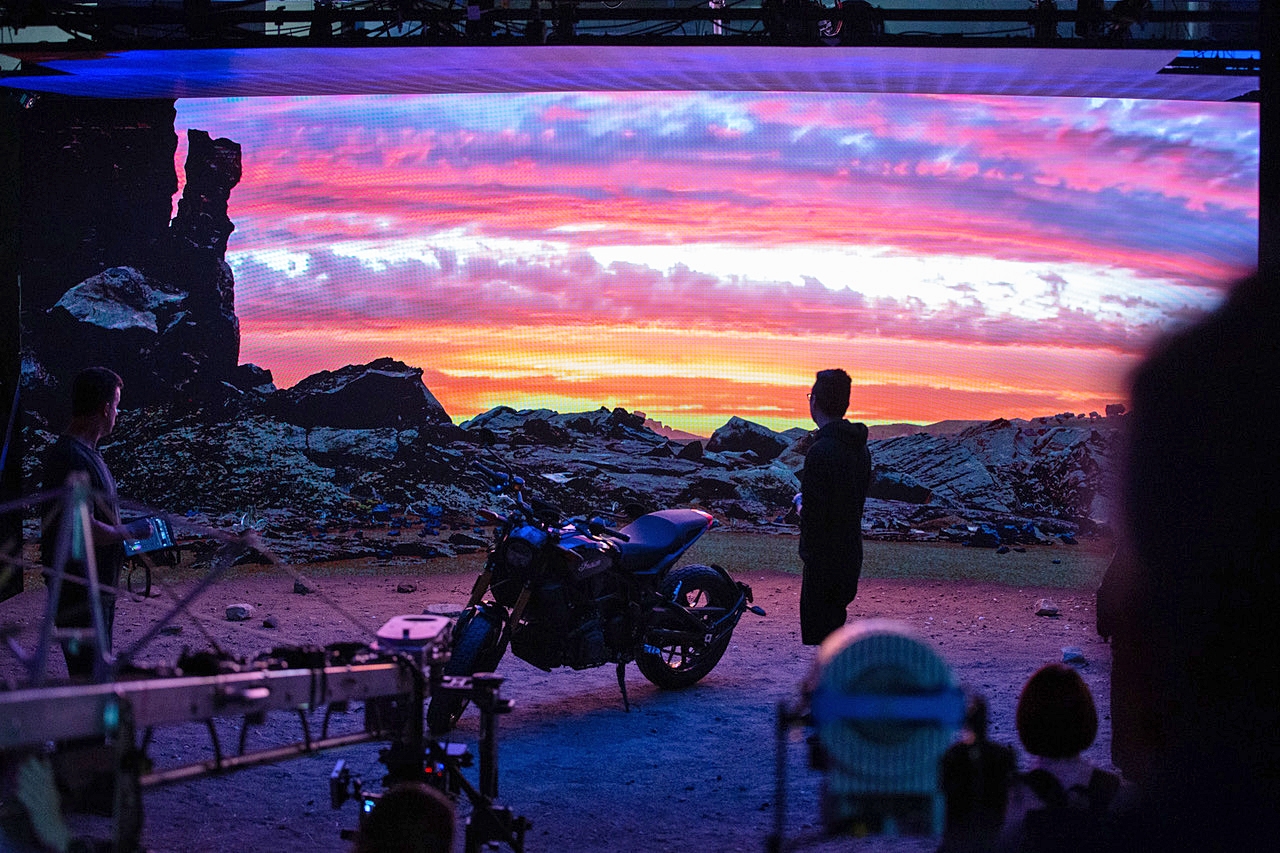
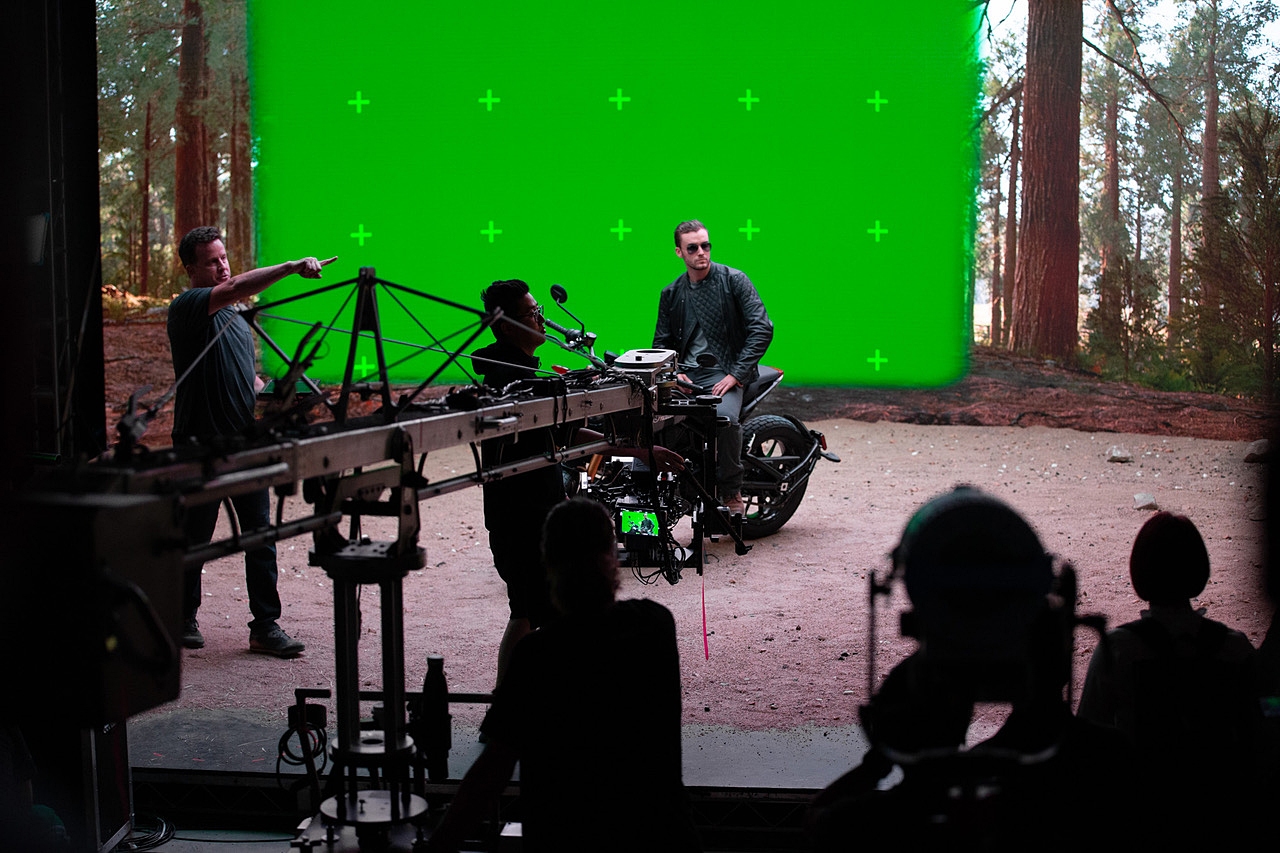
For The Mandalorian, an LED-wall system known as “the Volume” allowed the filmmakers to capture actors in a photo-real (or nearly so) environment, in-camera and in real time, with the aid of Epic Games’ Unreal Engine.

Traditional 3D animation applications such as Autodesk’s Maya and 3ds Max have long played a significant role in visual effects. Their comparatively slower performance, however, has seen their benefit focused more on pre- and postproduction, where time is somewhat less critical than in live-action production. These 3D apps prioritize final image quality over performance; as a result, image render times can easily stretch into hours or even days per frame, depending on the complexity of the shot and the computational power of the hardware.

By contrast, game engines were initially optimized for speed first and image quality second, in order to support gameplay in real-time, often at frame rates of 60 frames per second or more. And in the past few years, major technical advancements in the graphics-processing unit (GPU) of computers have enabled such engines to render production-quality imagery while maintaining their real-time speed. 

Commensurate with these hardware improvements, developers such as Epic Games (creators of Unreal Engine) and Unity Technologies (creators of Unity) have optimized their software for direct inclusion into the production pipelines of features and television. These changes are intended to support the crossover between traditional cinematography and computer-generated imagery — a dynamic that can serve filmmakers in a whole host of ways.

Matt Workman, a cinematographer and software developer, is working to erode even further the boundaries between filmmaking and CG with his creation of Cine Tracer, a real-time cinematography simulator built with Unreal Engine. The application — offered directly to filmmakers — enables the viewing of real-world camera and lighting equivalents in simulated, user-designed movie sets to produce highly accurate shot visualization.
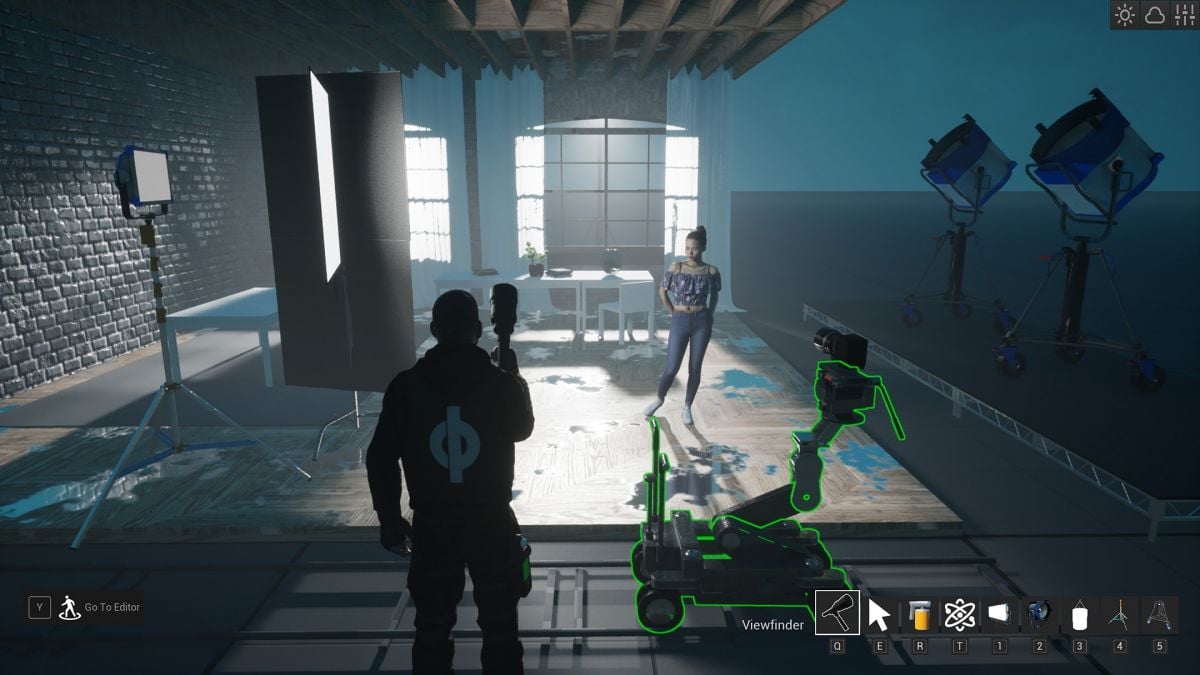
Director of photography and previs artist Matt Workman’s real-time “cinematography simulator” Cine Tracer is powered by Unreal Engine. (Screen capture.)

“My background includes about 10 years of traditional cinematography, mostly in commercials around New York City,” Workman says. “During that time, I worked with a lot of visual-effects companies on effects-heavy commercials — so I started creating previs tools to communicate in 3D and plan with the teams. A couple of years ago, I started developing Cine Tracer to handle that workflow more efficiently. I [designed] it as a video game [that’s controlled similarly to playing a third-person shooter game], but it’s intended to help filmmakers quickly visualize their shots. 

“I went to school for computer science, but I’ve always been tinkering with 3D,” he says. “Luckily, it’s 2020 and there’s YouTube, so the amount of available free education is incredible, as long as you have the time and the patience to learn. 

“Most cinematographers who are on the technical side pick up [game-engine-powered previsualization] very quickly. If you want to add light coming through the window, the steps to get there are very quick. It’s the same way you do it in the real world.”
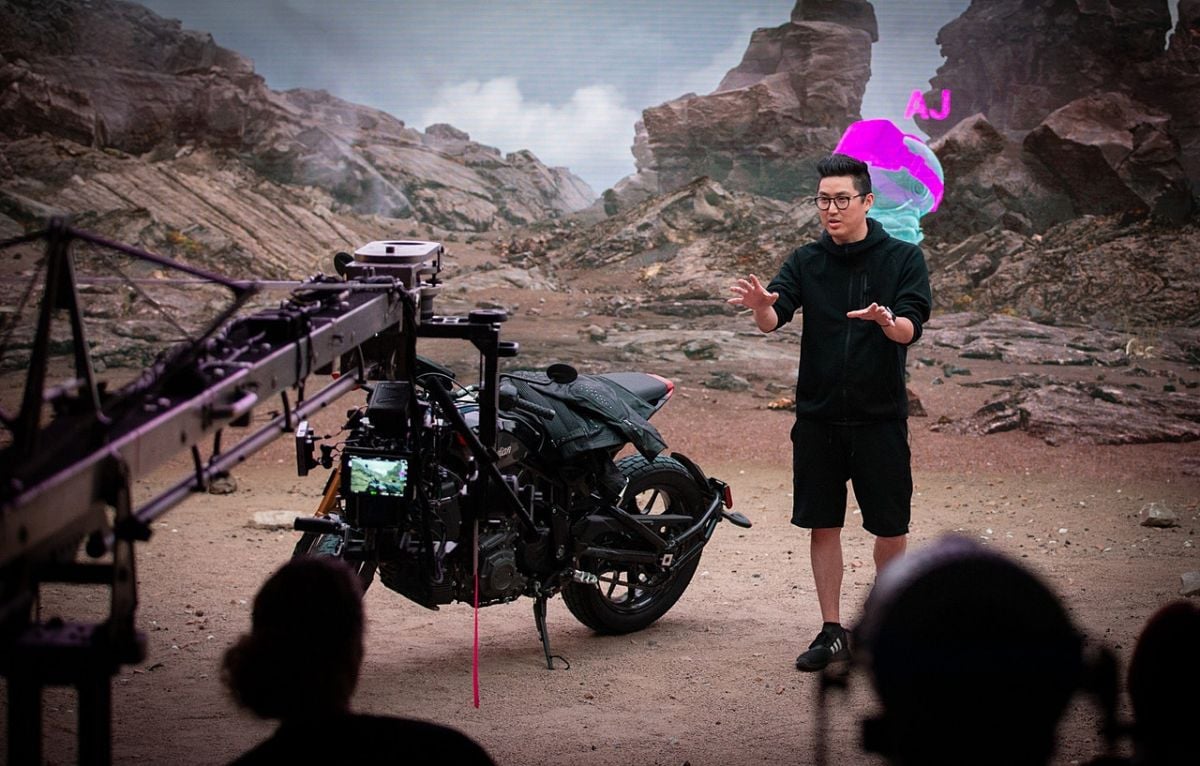
Workman at a demo of an LED Volume. The realistic background is actually an image that appears on the LED wall.

Regarding the primary advantage that real-time engines have over the more traditional computer-animation software, Workman notes, “The iteration time is much faster. If you want to see a camera move [for a specific shot] in order to determine, for example, what it would look like if you start close and then pull out wide — to see that change with Maya, you’re taking up to a couple of hours to render maybe 120 frames at high quality. In Unreal, that change happens instantly.” 

Visualization studios like The Third Floor have leveraged Unreal and other real-time engines on projects for the past several years to design previs, techvis and postvis services, and other forms of animation used in various phases of the production chain. The Third Floor’s credits span multiple Marvel movies, The Rise of Skywalker, (AC Feb. ’20) and other recent Star Wars films, as well as popular episodic series such as The Mandalorian and Game of Thrones (AC May ‘12 and July ‘19).

Casey Schatz, The Third Floor’s head of virtual production, has worked on such projects as Thor: Ragnarok (AC Dec. ‘17), Gemini Man (AC Nov. ‘19) and The Mandalorian, and has helped innovate everything from flame-throwing motion-control robots to real-time virtual eyelines. 

In addition to the obvious benefits of real-time rendering, Schatz, sees these software and hardware innovations as facilitating greater direct collaboration between studios like The Third Floor and cinematographers. “Historically, as previs creators, we were brought in very early, often before the DP was even hired,” he says. “So a certain amount of work had already been done, and when the cinematographer finally came on, they often felt like they were just painting by numbers. No one in visual effects wants that approach. We’re all trying to blend in with the wheel of filmmaking that’s existed since the Lumière brothers.

“Just a few years ago, game engines weren’t as conducive to moviemaking. Unreal’s virtual camera didn’t have a focal length or a film back [aka aperture gate] — it just had a field of view. Now there’s focal length, film backs, depth of field, f-stops, ISO and shutter speed. Epic even added the ACES color workflow into the rendering pipeline.

“A respect for and acknowledgment of traditional filmmaking has made its way into the software,” Schatz adds. “So you can say, ‘I’m shooting anamorphic with Panavision Primos,’ and we’ll have a menu of those exact focal lengths so that you can’t previsualize a focal length that doesn’t exist in your real lens kit.

“The goal has always been that even someone that has never touched a computer before, but is a remarkable cinematographer, can sit down next to a computer artist and talk in the language that they’re comfortable with — f-stops, T-stops, shutter speeds, film ISOs, grain, bounce light, diffuse light — the traditional cinematography terms that have existed for more than 100 years.” — Casey Schatz, The Third Floor’s head of virtual production 

“I’m working on the Avatar sequels now using Gazebo, Weta Digital’s proprietary real-time engine,” he says. “Russell Carpenter [ASC], the movies’ cinematographer, sat down with the lighters before we did any of our live action in New Zealand. Together they set the tone, the mood, the general key-light direction, the key-to-fill ratio, et cetera; all of this was done using  [cinema terminology] Russell is accustomed to. Thus, the line in the sand between traditional cinematography and computer graphics is disappearing more and more every day.”

Indeed, the rendering time of high-resolution interactive imagery has advanced to the point that it can actually appear onscreen as-is or with minimal adjustments in post — as employed, for example, on The Mandalorian.“That was our goal,” said Greig Fraser, ASC, ACS (who shot the Disney Plus Star Wars series along with Barry “Baz” Idoine), as reported in AC’s February 2020 issue. “We wanted to create an environment that was conducive not just to giving a composition line-up to the effects, but to actually capturing them in real time, photo-real and in-camera, so that the actors were in that environment in the right lighting — all at the moment of photography.”

When asked which specific advancements in real-time engines have pushed forward their synergy with traditional cinematography, Schatz explains that the ability to simulate bounce light, something so fundamental to traditional cinematography, is a game changer because only recently could this happen in real time or even close to it. “[During a previs session] a traditional cinematographer could be looking at a shot and say, ‘If we put a Kino Flo 6 feet away and add a bounce card, what would be the result?’ We can now show that result very quickly and accurately. Prior to these advancements, computer lighting was more analogous to theatrical lighting; you could aim a light and cast a shadow, but then you would have to cheat a bounce light by adding other lights to the sides at lower intensities.”

One of Schatz’s Third Floor colleagues, real-time developer Johnson Thomasson (The Mandalorian, Venom, Godzilla: King of the Monsters [AC June ‘19]), is quite directly involved with the intersection of live-action cinematography and real-time animation — specifically via motion capture and “virtual-camera sessions.” 

“One of the major benefits to real-time animation is ‘practice time’ for the filmmakers,” Thomasson says. “We worked on Christopher Robin, and director of photography Matthias Koenigswieser was able to use a virtual camera rig, playing back animation from the film and recording his camera motion so he could practice operating. He was able to directly experience the size difference between 12-inch tall Piglet and [for scenes set in the title character’s early years] 4-foot-tall Christopher Robin.

“It was a real challenge framing both of them, and something he hadn’t considered before coming to our virtual-camera sessions,” Thomasson continues. “It allowed Matthias to design his compositions ahead of the actual production. He was shooting with an empty frame [aka, a clean plate] on the day, but having rehearsed virtually, he already knew what the right framing felt like. When directors and DPs go through a virtual-camera session, they discover new ideas, and they’re exploring, expanding and coalescing their creativity.

“Another benefit is the physical representation of depth of field, which has never been rendered well in previs in the past,” Thomasson adds. “Unreal’s depth-of-field camera model is based on real-world cameras. So a cinematographer can ask which stop we’re at in a virtual-camera session and get an answer that reflects a physically accurate visual model. In my experience, when DPs learn about that capability, they want to take advantage of it, because depth of field is one of the strongest tools in their toolset for communicating their choices in cinematic language early on in preproduction.

“For directors who are not veterans of giant visual-effects tentpole films, it’s a new experience when they first get to the set. But [prepping] in a low-pressure, small-audience situation, and exploring and practicing via [real-time interactive previs], prepares them for the set like nothing else could.”

Looking toward the future, Schatz sees game engines becoming further entwined with live-action cinematography. “The hardware and software are going to [continue to advance], and it might almost become indistinguishable in terms of which imagery is real-time and which isn’t,” he says. “This is in service of the story and not to show off the technology. The motto of the Previsualization Society is ‘fix it in pre.’ The more creative decisions you can interactively figure out before you get on set, the better.

“The goal has always been that even someone that has never touched a computer before, but is a remarkable cinematographer, can sit down next to a computer artist and talk in the language that they’re comfortable with — f-stops, T-stops, shutter speeds, film ISOs, grain, bounce light, diffuse light — the traditional cinematography terms that have existed for more than 100 years.”

Workman adds, “What directors want are iterations. They want to find all the possible challenges early, so the faster you can see a result, understand the issues and create another iteration, the better. Real-time engines make that process happen instantly. It’s just like playing a video game.”


Prep Becomes Production
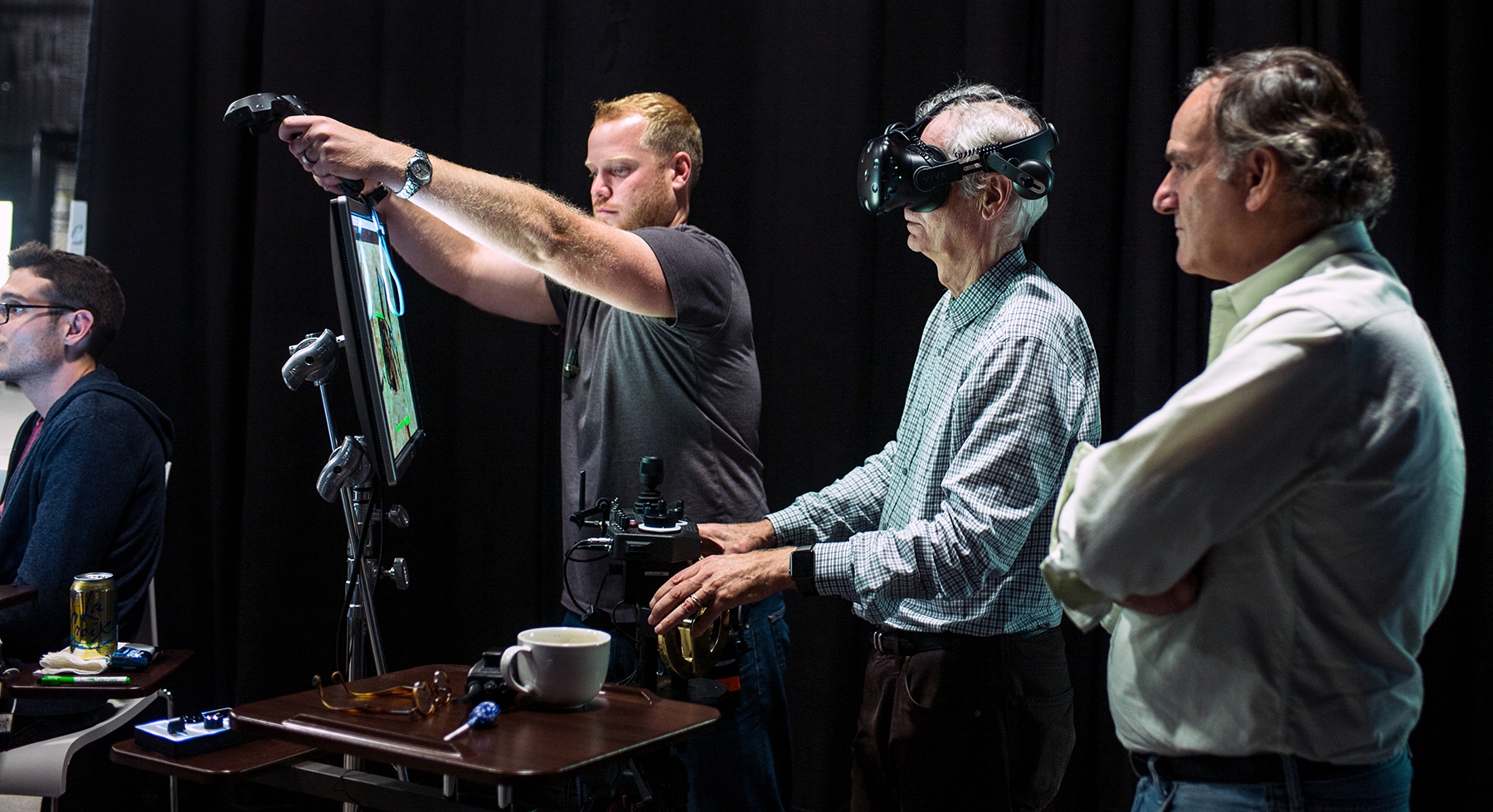
Society members Caleb Deschanel (wearing goggles) and Robert Legato (right), alongside Magnopus virtual-production producer A.J. Sciutto, at work on the photo-real animated feature The Lion King, which was produced with the aid of the Unity game engine.

Game-engine technology can provide cinematographers with ways to previsualize in a simulated filmmaking environment — but it can also serve as a filmmaking medium in itself. With the aid of game-engine tech, veteran cinematographer Caleb Deschanel, ASC leveraged his extensive traditional cinematography experience to capture The Lion King with entirely virtual characters, and settings as well (save for a single shot). Making this possible was visual-effects supervisor Robert Legato, ASC and a team of technicians and artists at Magnopus, who coupled the Unity game engine with various traditional dollies, cranes, tripods and other camera-movement tools to enable Deschanel to manually operate virtual cameras while directly interacting with live animation. 

“The essential thing for me in filming this way is having enough visual detail so I can make the same kind of decisions I always make on a set,” Deschanel tells AC. “That informs how you compose the shot and how you light it.” Though not yet photo-real — as the process to make them so would unfold later at MPC in London — the filmmakers’ subjects were imbued with enough detail by the real-time interactive system “that you can read their emotions and understand how close or how wide you need to be,” Deschanel says.
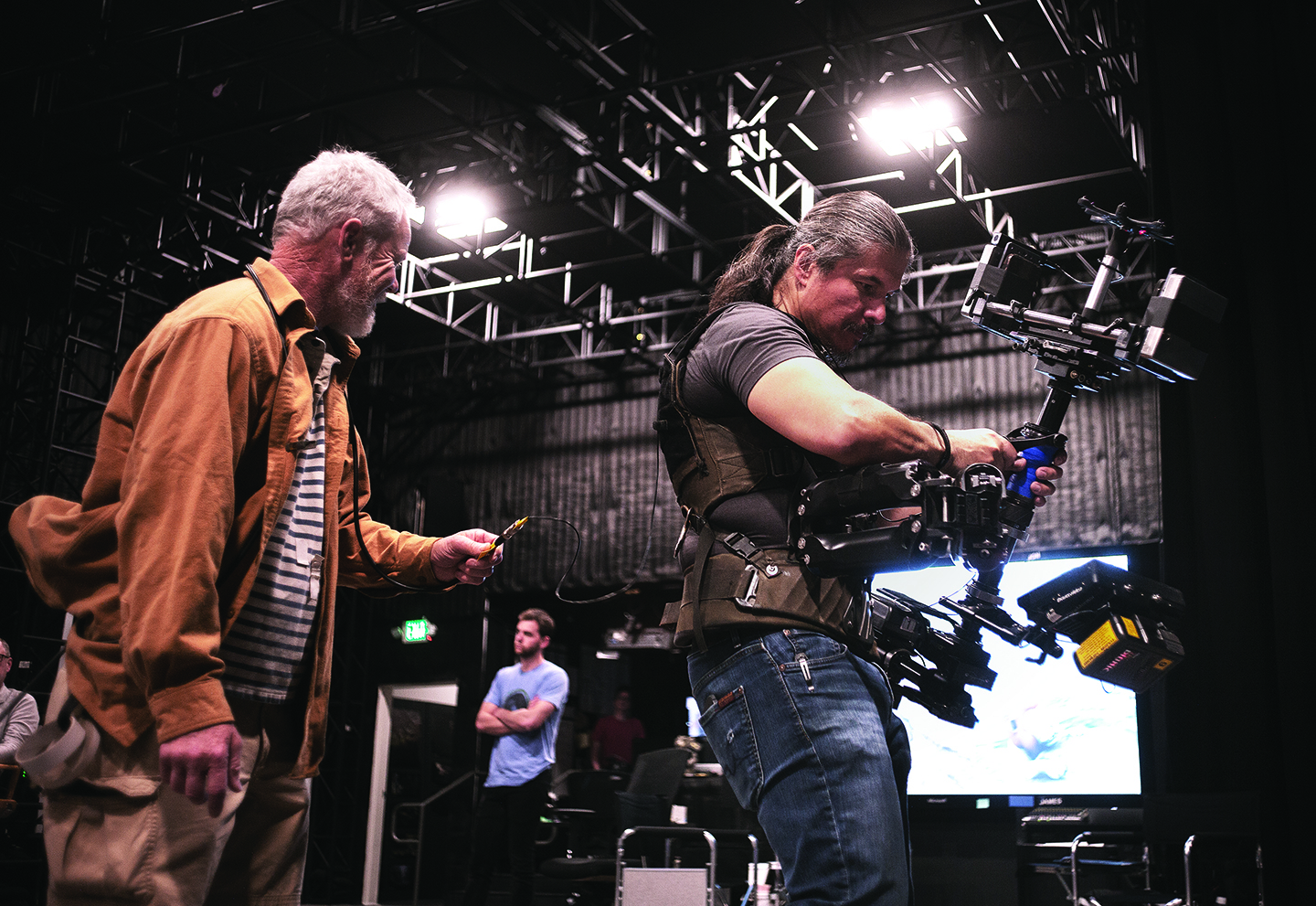
Legato — who was a key member of the virtual-camera crew in addition to his role in developing the technology — adds, “We’re essentially motion-capturing the Steadicam operator attached to the Steadicam or a dolly grip attached to the dolly. With the game engine, everything is live and under your control. You just walk over to the place that seems the most appropriate for you to film it. And because it’s live, you can say, ‘Let me get a little lower or a little higher, or let me try this same position with a 20mm instead of a 24.’ You’re tapping into your on-set intuition, which is ultimately years and years of experience, instead of overintellectualizing it.”

With these tools at their disposal, Deschanel and crew could not only capture the motion and composition of their virtual cinematography, but make visual design choices as well. “I would sit with [lighting director] Sam Maniscalco, who was my gaffer, with the files of all the sets,” Deschanel recalls. “We had a choice of 350 different skies to give us the right mood for every scene. It was just like being a cinematographer [in a traditional environment], but having far more control than you normally would. On a [traditional set], you don’t have control over the clouds and sky, so you have to follow the sun throughout the day. It was exciting and a lot of fun — I was really surprised.” — Noah Kadner
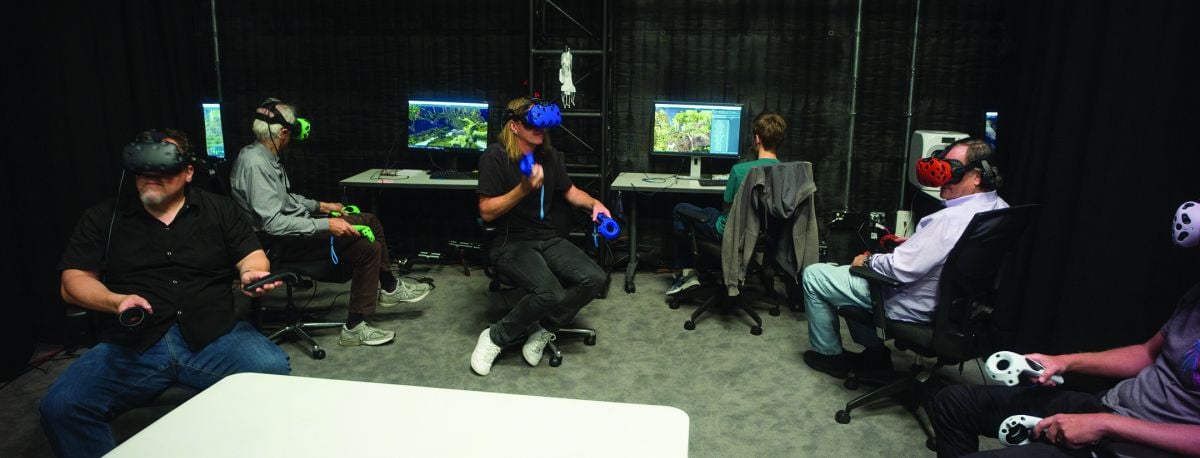
From left: The Lion King director Jon Favreau, Deschanel and production designer James Chinlund explore the previsualized world.


Saturday, February 27, 2021

REPOST: What Every Game Designer Should Know About Human Psychology [02.25.21] - Michael Moran

https://www.gamecareerguide.com/features/1987/what_every_game_designer_should_.php

Discover more from Informa Tech
  • From door handles to coffee mugs to fighter jet cockpits, User Experience shows up in everything you interact with.

    Every human-made object has been designed, based on either what will be easier for the user or what was easiest for the manufacturer. (Whenever using something feels frustrating or confusing, you can be sure it was the latter!)

    But what about the concept of User Experience in the world of video games?

    When our brains process something as complex as a video game, there's a lot going on. Understanding the role that psychology plays within the science of game development is crucial to creating memorable and engaging games.

    In this article, we'll summarize the importance of understanding psychology while crafting the user experience of a video game.

    We'll touch on subjects such as the importance of play-testing, employing affordance in your games, how to use psychology to create usability and engageability, and the role of the "Gestalt" theory in game design.

    Why Design Should Always Focus On The User

    When the design is focused on the perspective of the user, a product becomes much more practical, desirable, and useful.

    A great example of this dates back to fighter pilots during WWII. Exhausted and under pressure, these pilots had a high rate of human error and were at risk of accidentally pushing the wrong button on the dashboard of their aircraft.

    Image for post
    WWII Spitfire Cockpit

    Unfortunately for them, dashboards were not consistent between aircraft. This meant the pilots had to learn a new set-up every time they switched planes.

    This made it even more likely that they would press the wrong button. Therefore, standardized cockpits needed to be developed which would improve the user experience for these pilots.

    This type of thinking can also be applied to video games, ensuring that the design of the game is centered around the user experience. Therefore, by understanding the psychology of the user, you'll be better able to make design decisions tailored to their needs.

    It's also important to remember that there is no such thing as a neutral design. Everything we design will  influence people to use it in one way or another .  This is an important ethical issue to consider, especially when certain retention mechanics can create addictive behaviors and punish disengagement .

    The Importance of Play-Testing

    Every user is different and  our perspective depends on our experience , our history and what is important to us. When designing video games for different types of users, it's not possible to know in advance what every user will bring to the experience. That's why it's essential to have a diverse team of designers with different backgrounds.

    That's also why video game designers "play test" their games. This tests how the game is perceived by the people who will actually be playing it. With this method designing a game becomes  a cycle of action and iteration .

    Designers create a game, then test it to see if it is accomplishing what they wanted to achieve. If insight from audience testing finds the game lacking, it's back to the drawing board to refine with more information. Then the game is tested again, and the cycle continues.

    The design team may have certain goals that they are trying to achieve within the game. However, they will need to iterate on all aspects of the gameplay, from dialogue to visuals to mechanics and more, in order to achieve those goals.

    When it comes to play testing, heres an important tip:  The developer shouldn't be in the room with the play testers . Not only will it make the players feel somewhat awkward and intimidated, it will also make the test less accurate.

    Players tend to make  more  effort to understand a game when the developer is watching than they would if they were playing it at home  (perhaps out of politeness to the person who has put their heart and soul into crafting the game). To get an accurate measure of how many players would simply give up on a game, play testers should be free to play the game by themselves.


Game Career Guide

https://www.gamecareerguide.com/


Thursday, March 26, 2020

Trying this out. Twine is an open-source tool for telling interactive, nonlinear stories.

Looks like an old program on Facebook? back in the day for a project I worked on.
===============================
 
https://twinery.org/

You don't need to write any code to create a simple story with Twine, but you can extend your stories with variables, conditional logic, images, CSS, and JavaScript when you're ready. 

Twine publishes directly to HTML, so you can post your work nearly anywhere. Anything you create with it is completely free to use any way you like, including for commercial purposes. 

Twine was originally created by Chris Klimas in 2009 and is now maintained by a whole bunch of people at several different repositories. 


A new tool has emerged that empowers just about anyone to create a game. It's called Twine. It's extremely easy to use, and it has already given rise to a lively and diverse development scene.
Carolyn Petit, Gamespot
 
Although plenty of independent games venture where mainstream games fear to tread, Twine represents something even more radical: the transformation of video games into something that is not only consumed by the masses but also created by them.
Laura Hudson, The New York Times Magazine
 
The simple beauty of Twine is this: if you can type words and occasionally put brackets around some of those words, you can make a Twine game.
Kitty Horrorshow
 
If you're interested in making interactive fiction then there's no better place to start than Twine. It's possibly the simplest game making tool available, it will take you mere minutes to get started, and it has a wonderfully simple visual editor.
Richard Perrin
 
And aside from being free, it's really not programming at all — if you can write a story, you can make a Twine game.
Anna Anthropy
 
Twine is the closest we've come to a blank page. It binds itself and it can bind itself along an infinite number of spines extending in any direction.
Porpentine

Tuesday, March 24, 2020

Video: Storytelling lessons learned in 14 years at BioWare _ March 20, 2020 | By Gamasutra Staff

https://gamasutra.com/view/news/359918/Video_Storytelling_lessons_learned_in_14_years_at_BioWare.php

In this 2018 GDC talk, former BioWare creative director Mike Laidlaw details some of the most important lessons he's learned about how narrative fits within games.

Plus, Laidlaw explored how writers and narrative designers tasked with bringing stories to life can gel into cohesive storytellers, while still working well with the larger game team.

If you missed seeing it live at GDC, take advantage of the fact that you can now watch Laidlaw's talk for free via the official GDC YouTube channel!

And of course, all week the official GDC Twitch channel will be livestreaming speaker-recorded talks that were planned for GDC 2020, originally slated to take place this week. Tune in now to watch, or check back later to watch the archives on Twitch or the official GDC YouTube channel!

About the GDC Vault

In addition to this presentation, the GDC Vault and its accompanying YouTube channel offers numerous other free videos, audio recordings, and slides from many of the recent Game Developers Conference events, and the service offers even more members-only content for GDC Vault subscribers.

Those who purchased All Access passes to recent events like GDC or VRDC already have full access to GDC Vault, and interested parties can apply for the individual subscription via a GDC Vault subscription page. Group subscriptions are also available: game-related schools and development studios who sign up for GDC Vault Studio Subscriptions can receive access for their entire office or company by contacting staff via the GDC Vault group subscription page. 

LUNA The Shadow Dust developer Beidi Guo on how lore and environmental storytelling increase replayability in puzzle games

https://gamasutra.com/blogs/OlegNesterenko/20200324/360006/LUNA_The_Shadow_Dust_developer_Beidi_Guo_on_how_lore_and_environmental_storytelling_increase_replayability_in_puzzle_games.php

The following blog post, unless otherwise noted, was written by a member of Gamasutra’s community.
The thoughts and opinions expressed are those of the writer and not Gamasutra or its parent company.


This interview was originally published on Game World Observer on March 24, 2020.
LUNA The Shadow Dust is a hand-animated point-and-click puzzle adventure that came out on February 13. It is the debut title of the Chinese team called Lantern Studio.

We sat down with Beidi Guo, art director on the game, to discuss ups and downs of the development process, as well as the general fate of puzzle games.

Beidi Guo Lantern Studio
One of the two is Beidi Guo, Art Director

Oleg Nesterenko, managing editor at GWO: Beidi, tell us about Lantern Studio.
There are four members on the team. There’s me. There’s Fox, who is our project manager. Susie Wang composed music for the game, and Wang Guan is our programmer. We are scattered around the world. We are based in London, Toronto, and Shanghai. We mostly keep in touch on Skype.
Susie and I are also in charge of social media, as well as reporting to our Kickstarter backers.

We try to do everything ourselves to save budget. But towards the end of the development, we hired our current marketing manager George Eastmead from Acorngames, who helped us manage our accounts on Facebook, Instagram, Reddit, Discord. For example, he also suggested cross-promotion with other teams. We have met a lot of other indie developers over these years, so when their games launch, we will RT for each other, or post some fan art featuring our characters but using their game style.

Update Oct04
A rare moment of Lantern Studio being physically together

Limited budget means that you have to be very selective about game conventions that you attend.

In the beginning, we tried to attend conventions that were free. Also there are organizations that help indie teams in the UK, like an organization called Tentacle Zone. They help indie developers hire space at big conventions like EGX Rezzed and Insomnia. They have a dedicated zone there called Tentacle Zone, and usually they offer indie developers booths and equipment.

Later, we signed with our publishers. They helped us promote our game at trade shows like GDC and Gamescom.

Good for you. But you weren’t quite as smart about your Kickstarter campaign, right? The money you raised only lasted you one year, and it took another three years to finish the game. How did that happen?

We lacked experience. We thought we could finish the game in one year. A year and a half, tops. But after we started the development, we realized that this game had way more potential than we anticipated. We had to decide whether to keep the game small so we could finish it within our budget or to try to get the game done the way we actually wanted. And this was probably two, three times larger than our original plan.

early comcep art LUNA
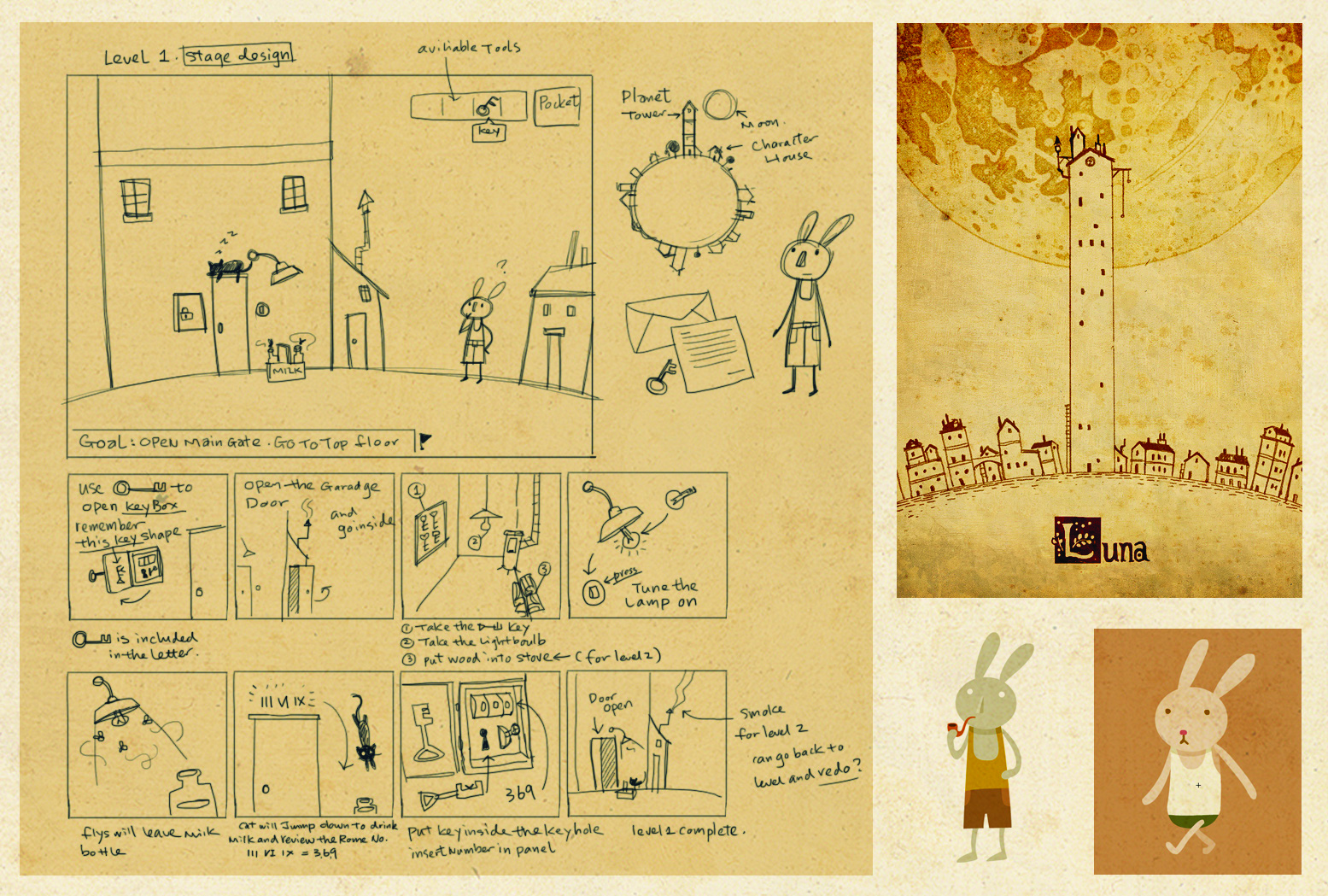
Beidi’s very first concept art for LUNA, when it was still a very small game that only existed in her head

We didn’t want to give up. All of us dipped into our savings and chipped in. This was enough to last us for another three years.

It was not an easy decision. We also had to apologize to our Kickstarter backers that this game was taking way longer than we promised. But our backers are very patient. Instead of rushing us, they agreed to wait for us to deliver a more complete experience, they have always shown us support and love, which was incredible.

And you didn’t want funding from your publishers?

We only signed with them in 2018, when most of the game was ready.

Before that, however, in 2017, a few individual investors had approached us to say they would like to invest in our game, but we turned that down. We wanted to keep our creative freedom in making LUNA.

If publishers offer funding, that often means they might interfere with your creative decisions. In certain cases, devs even sell their IP to their publisher, which is something we definitely don’t recommend. If you don’t own your game, what’s the point of being indie?

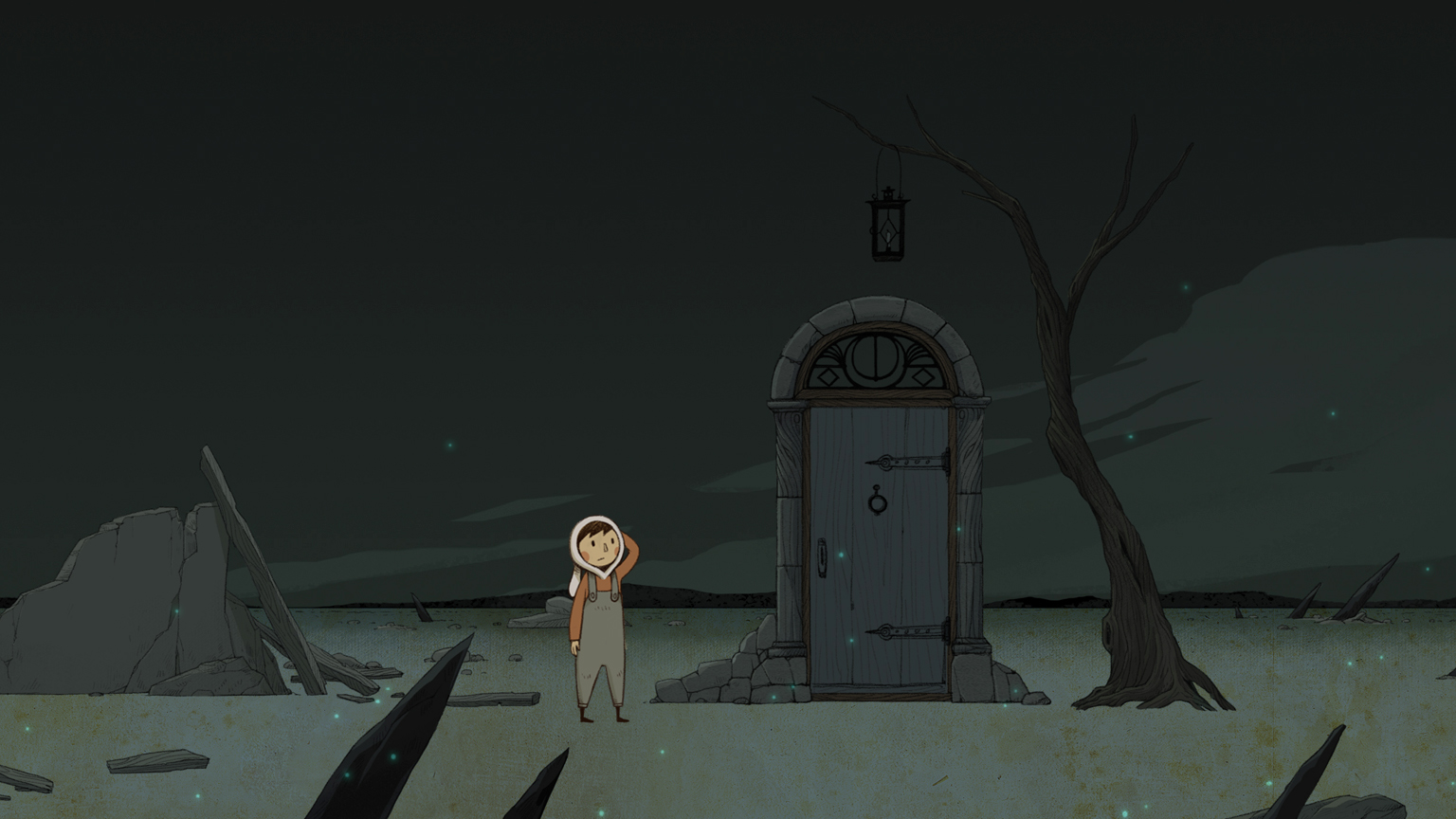
screenshot03
That must have been some pretty dark times, risking your own money, not knowing exactly what to do with your game…

It was tough, but at least we could do something about it. The hardest times were when unpredictable situations happened that were completely out of our control.

For example, when we needed to publish our game in China. By the lastest regulation, you need to apply for a license. We had to queue a year early because we knew it was going to take a while, but we didn’t know how long exactly. Throughout the whole process, there is no way you can check with the staff in the relevant department. Ask them “How’s it going? Is there any extra document we need to supply?” The communication is strictly one-sided. If they find a problem, they will get back to you and ask you to fix it. Then you have to re-submit which was really time consuming.

We never expected this because the law only came into force in early 2018. And we definitely wanted to publish our game in China. We are a Chinese team, and a lot of Chinese players supported us. No way we could let them down.

This was probably the hardest time. I mean you want to start to market your game almost half a year before you launch it. But without knowing when we were getting this license, we couldn’t really start any promotion. And we didn’t want to promote our game too early. If you promote for too long, people can get tired of waiting. This caused us lots of anxiety on top of the existing health problems. There was literally nothing we could do but wait and pray.

Eventually we got the license after nine months.

screenshot01

Health problems, you said?

It is a common problem among all indies, when you don’t have enough budget to afford a healthy lifestyle. No extra money to spend on gym or eating healthy. And you are working from home, so it’s kind of lonely as well.

And we tried not to take any time off because we were already way behind our original schedule. Towards the end of the development, it started taking a toll on the health of some of our team members. We were burnt out. It felt like all creativity was squeezed out of us. We looked at our game, and all we could see was bugs.

Last year, while we were still waiting for that license, the whole team decided to take a couple of weeks off so we could recover from this burnout.

Pray and take breaks. Essential advice for all indies out there. Let’s talk about the game itself. How did you come up with an idea for LUNA?

The general philosophy behind the game was inspired by the Earthsea series written by Ursula K. Le Guin. Her novels are never one-dimensional, it’s not just the hero versus evil, the light versus the dark side. She emphasizes how everything is interconnected. Without shadow, there will be no light, and vice versa. It’s something we don’t really see in the majority of games nowadays.

Which is why there is no evil in LUNA. There are no boss fights. It’s more about a balance. The more light you create, the more shadow will follow. One’s ambition of becoming the best and doing the good deeds can also cause devastating consequences.

LUNA_gif_04

How did you design the puzzles?

In the beginning of the development, we just brainstormed for a couple of weeks. We created a folder called “Crazy Ideas.” And we threw in all kinds of ideas, whether it was on mechanics, visuals or the story. At this stage, we didn’t even think if these ideas could get us anywhere.

When we run out of ideas, we all sat down to mix and match different concepts. For example, we have a room with a lot of objects lying around. So it might be fun to introduce a gameplay where people need loads of stuff to interact with.

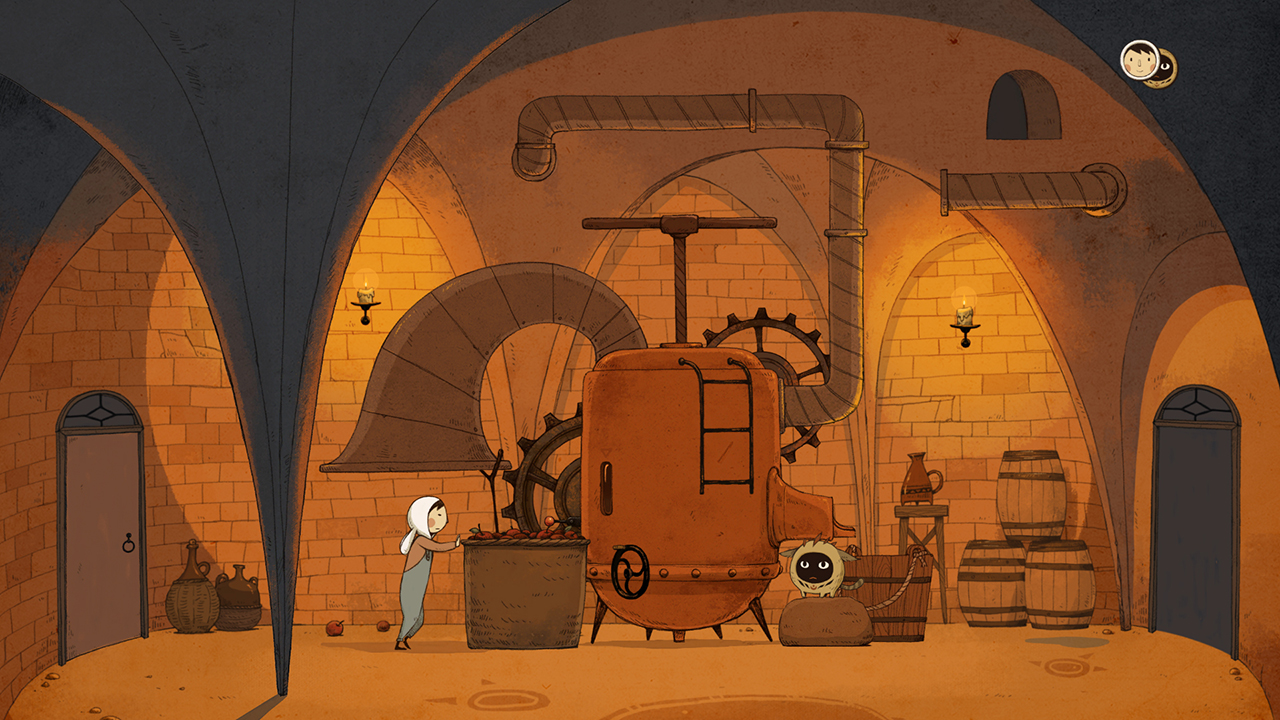
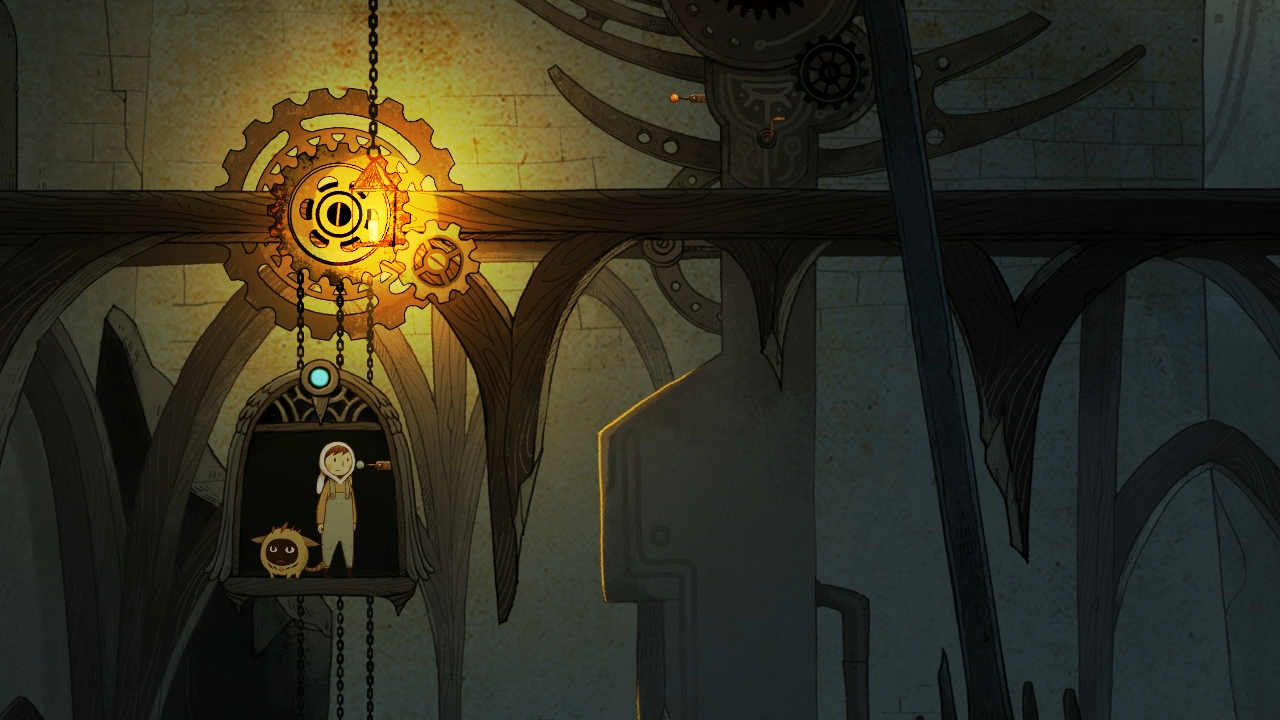
Or the other way around. For example, we came up with this mechanic that we really liked. You know, when the character can turn into a shadow. So we think, okay, what setting is suitable for this kind of gameplay? Probably you need a room with walls. It can’t happen outdoors. And to emphasize the contrast between light and dark, this room needs a very strong light source. So you can have lots of candles. That’s how we came with an idea of a room for this puzzle.

We just tried to fill each room with the suitable mechanic and gameplay. But all of this changed throughout the development. For some of the rooms we couldn’t figure out the right mechanic. Or we started developing and then realized that it wasn’t as fun as we thought or it had nothing to do with our story.

Then we gave up some of the levels that were already in development. We also got rid of ideas that were technically too challenging for us.

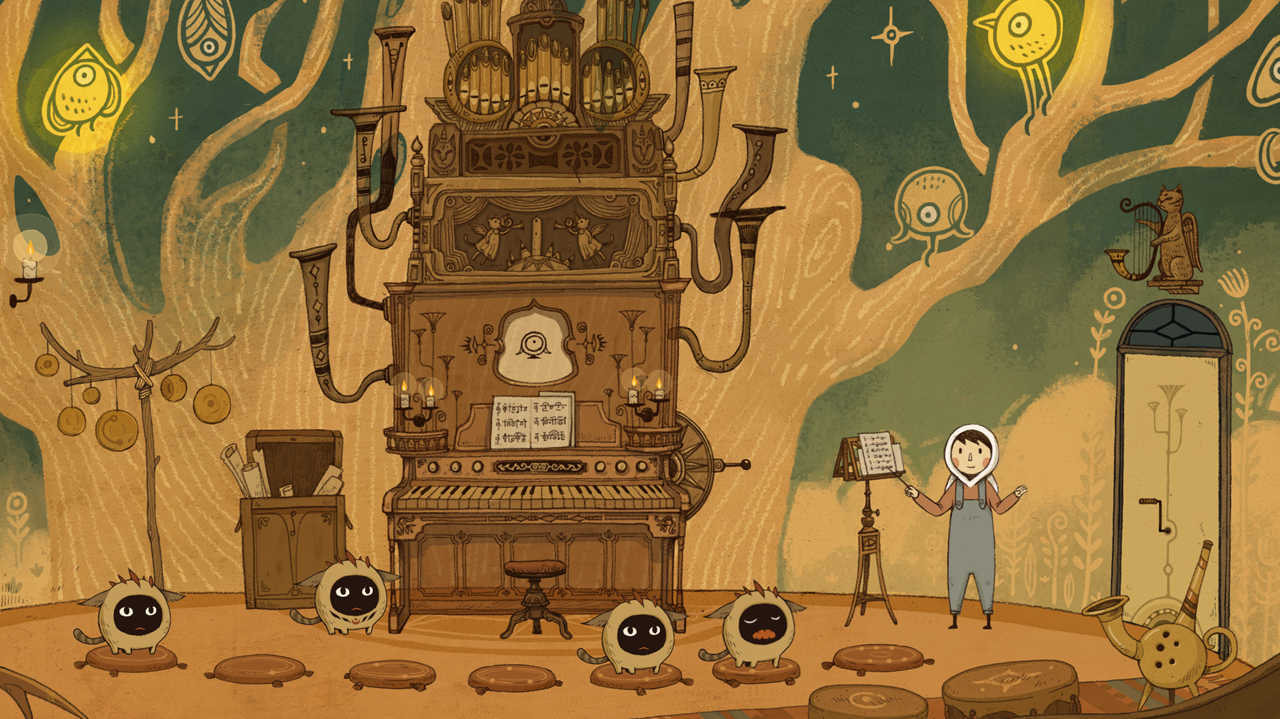
screenshot08

Did you playtest your puzzles?

Feedback from players is crucial. The four of us, we think very much alike and sometimes we can’t help but develop this sort of tunnel vision, stuck in our own judgement. Therefore, whenever we finished a level, we tried to invite as many people as we could to test it.

First of all, we would invite our game designer friends from the industry. They are professionals so they would give us feedback from a design point of view. After that, when we fixed some of the gameplay issues, we would give it to more casual players.

That included our friends, our families, who don’t even play games. But we like to know what their first impression is. Because sometimes when we thought a puzzle was easy but we found a lot of people got stuck. We need to ask them for feedback. We want to know their way of approaching the puzzles, was the hint not visible enough, or is there a confusion about the UI design? Then we have to fix these issues.

That’s another important reason for us to go to game conventions. You embrace hundreds of players. You can stand behind them, watch them, see exactly how they interact with a level. And then you talk to them. That’s how we collect data.

According to feedback from players, we constantly fine-tune one aspect or another. Some levels have been developed very smoothly, others went through multiple iterations.

You can’t test them forever though. When do you know that a level is complete?

Once you have around 50 or 30 people giving you the same feedback, it’s safe to say that we know how most of the audience is gonna react toward this level. However, there will always be players that think differently, we just have to embrace that.

Getting individual puzzles right is hard enough, but you also have to think about their place on a difficulty curve.

A good learning curve is difficult to nail. This is something we also test on players. We did a lot of fine-tuning at the later stage changing the order of certain puzzles to see which sequence works the best.

We discovered, for example, that the difficulty should be uneven towards the end. If players have been playing a game for hours, puzzles of the same difficulty might seem more difficult because people are just tired. So we need to throw in one or two levels in between that are relatively easy to give them some time to recover, to just enjoy the story and the environment.

screenshot05

After all this fine-tuning, are there any weaknesses in LUNA that you can think of?

Perhaps we tried too hard to be original. This is why sometimes we made our puzzles too different from each other. One of the common pieces of feedback that we received is that there is not enough continuity between puzzles. You learn a skill in the beginning of the game but then you have to wait for a very long time to use that ability again. We might be able to improve that in the future.

We also tried too hard to appeal to a broad audience. I wish we had understood earlier who our core audience was. If we had communicated with them more, probably we could have avoided some easy but less interesting puzzles that just tried to make sure everyone can pass the early stage of the game.

I mean, this is our first game. We were not that confident about our decisions sometimes. In hindsight, I would say that for an indie team it’s ok to make a game the general public will criticize as long as your key audience really likes it. They will tell their friends about your game, and that’s how you slowly reach the audience that you are aiming for. You might not be able to find it right away because it’s a niche market, and there are always risks involved when you do something new. People are usually more comfortable with the things they are used to, I guess.

Do you now have a better idea of who your target audience is?

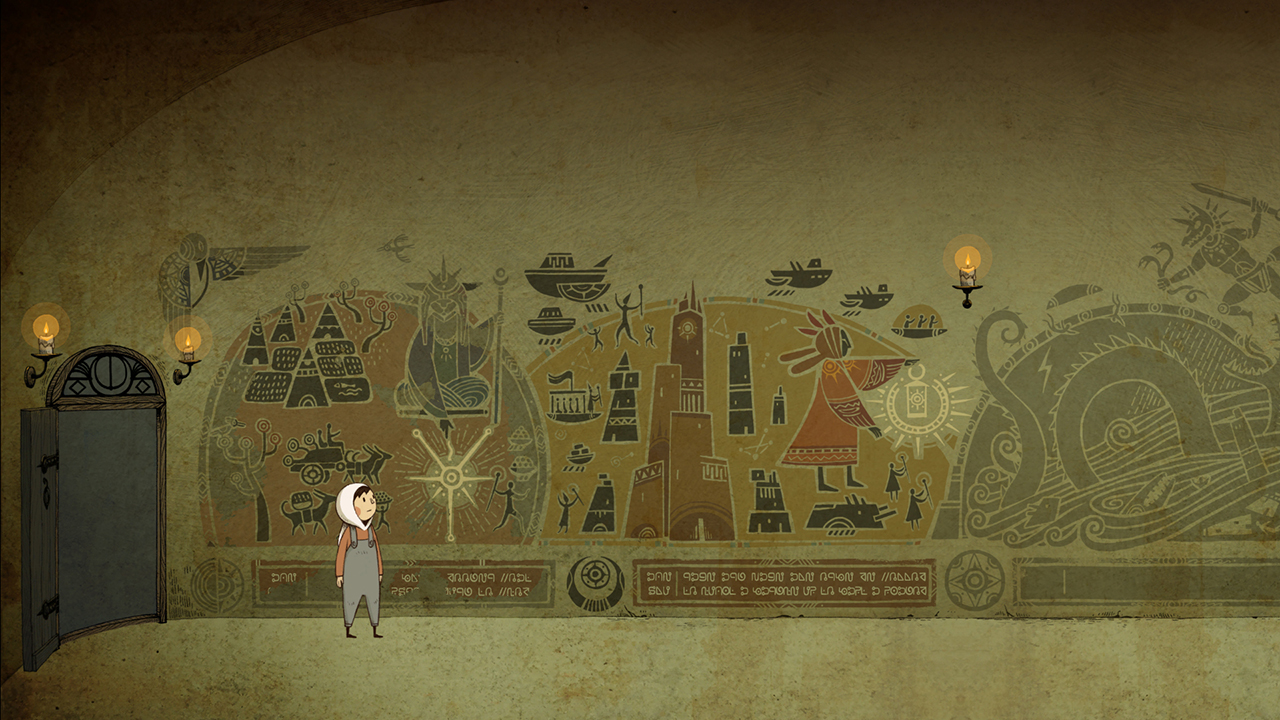
It’s people who like to take their time and enjoy every detail in the game. Whenever they finish a puzzle, they don’t just rush to the next level so they can beat the whole game in two hours. They like to linger around and look at those paintings and try to use their imagination to figure out the lore, the background story.

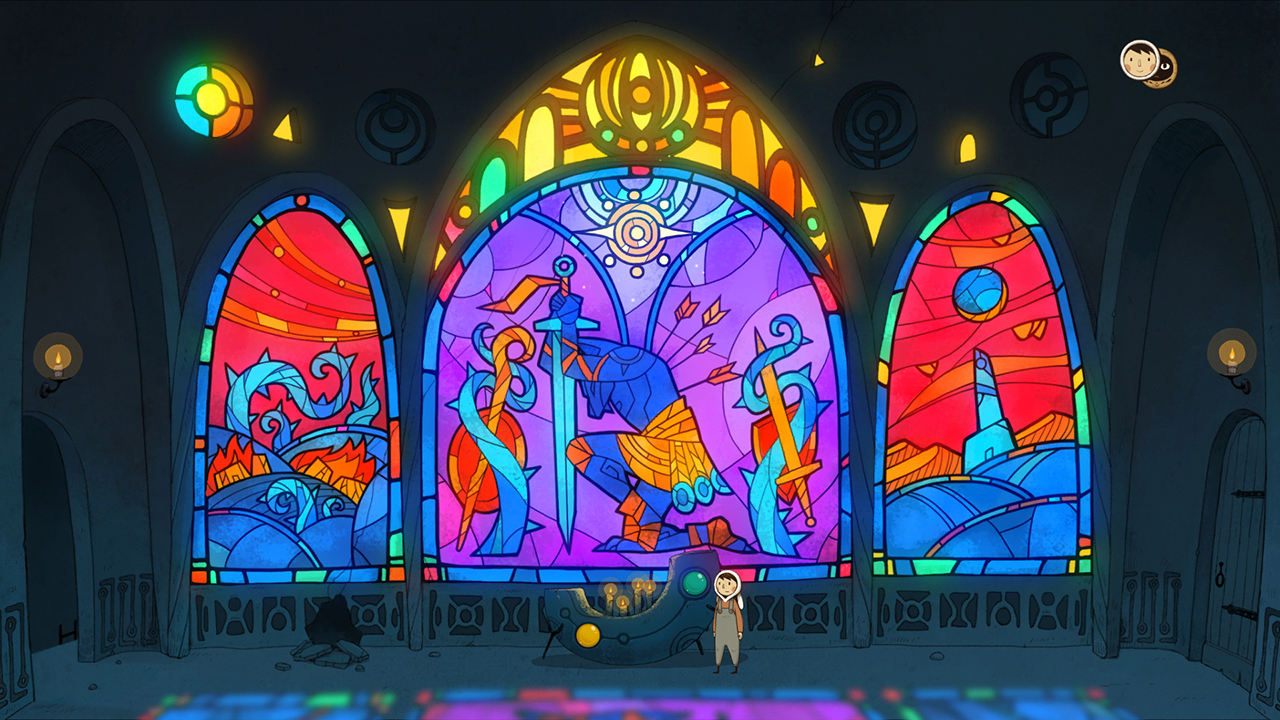
screenshot13

Many people found them somewhat obscure. Did you devise them that way to encourage players to slow down when playing the game?

We definitely didn’t want to confuse people. We tried to make the story understandable by the majority of people. We tried to use the universal cinematic language. For flashbacks, for example, we used a different tone so people understand that this bit happened in the past. Or, another example, in so many cartoons and tv shows,  whenever you hear a harp playing, you know that this is some memory from the past. This is the kind of cinematic language we tried in our game.

Sometimes, though, it’s ok to leave it up to the player to figure things out for themselves. I trust players. They chose to play a puzzle game without a single line of dialogue, that means they have certain expectations about being challenged, they have certain expectations about themselves and are able to figure things out.

So yes, it’s about how you play it.

A lot of the lore of the story is embedded in individual rooms. Once you have completed enough of the game, you also realize that the whole tower actually is a place designed for a few people to live there. There are kitchens, there are bedrooms. They are not just random stage props. If  you start to wonder who actually lives there, which bedroom is connected with which character based on the decorations in the background, you might figure out what kind of relationship there is between these characters.

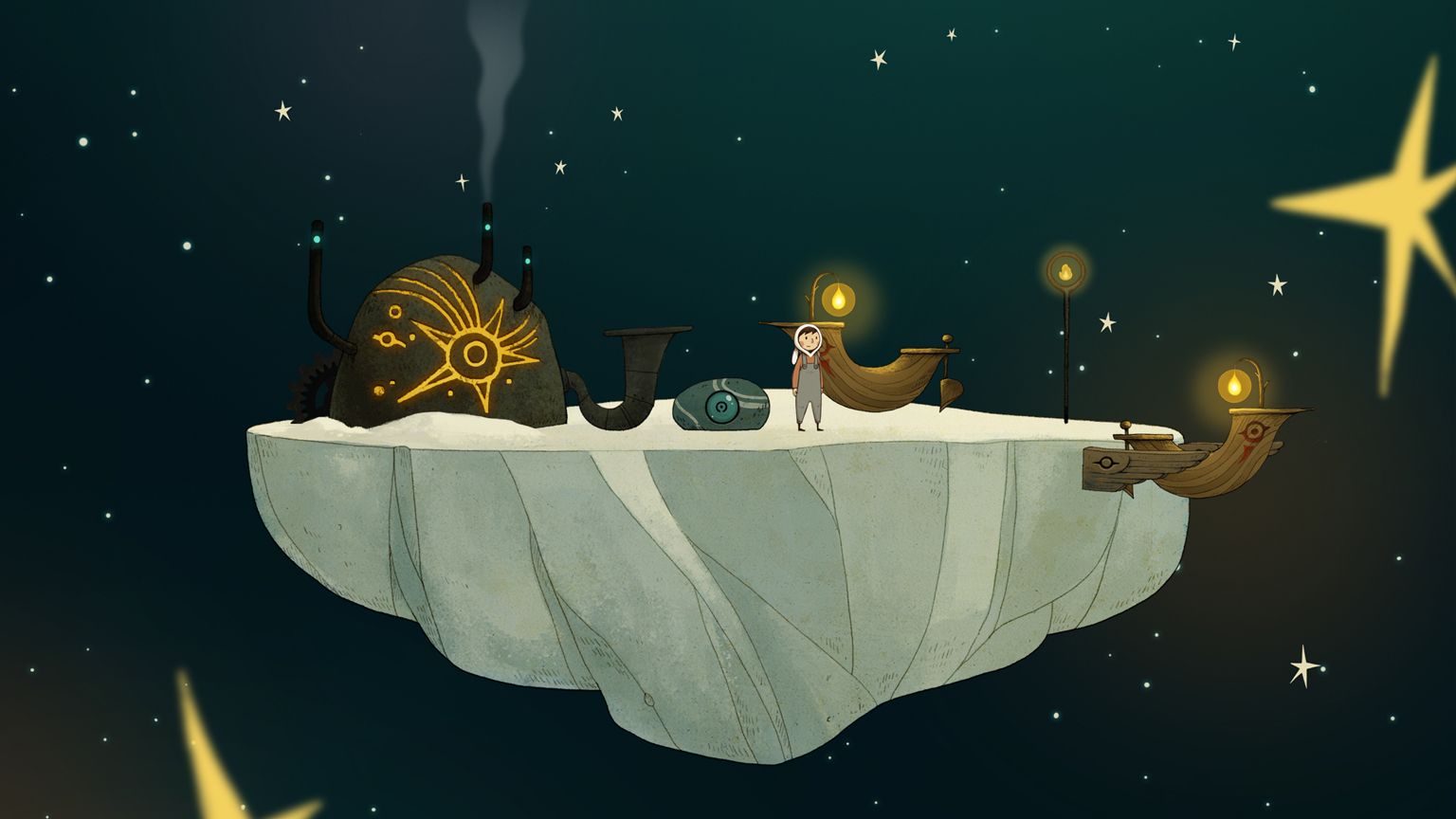
screenshot02

Was it even worth it? Inventing all this rich narrative that might be completely lost on players who just want to beat the game?

Absolutely. People do not typically replay puzzle games. But what we saw with LUNA is that many players return to the game because they didn’t get every single detail at their first go. They don’t replay it for the sake of puzzles. They just want to get the full picture of the story.
For these players, we even designed some Easter eggs.

For example, one of the cutscenes cannot be activated in the first round. You will see it still locked in the gallery. We hope this will encourage people to wonder if they have missed something.
You need to revisit some locations and rethink your previous assumptions to unlock this extra bit of the story.

We’ve also designed a LUNA language which is decodable. Amazingly, many people decoded it in the first 24 hours. So if you know how to decode it, you can actually go back to the game and read those writings in books, in paintings on the wall. That’s something that a lot of YouTubers did on their streams.We’re really happy to see players willing to spend so much time in doing this.

Unlocking all these secrets will answer some of the questions, but probably raise some new ones. We hope that people who are really interested in the setting of the world will then move from the game to our website because we keep a very detailed devlog and we made some interviews that explain the lore behind the story. Also we have a lot of behind the scene design process, sketches and images included in our digital artbook, which is also available on Steam.

screenshot07

So it was an artistic decision to not use any real language in the game?

It was both a pragmatic and a creative decision.

Sometimes when I play a game which is dialogue heavy, I switch between English and Chinese. More often than not, a lot of jokes, a lot of puns get lost in the translation. It was really a shame but I also understood translating these is very difficult. So even if you localize your game, some meaning will still get lost in translation.

However, we can all understand emotions by looking at characters’ facial expressions and movement. It is the universal language we all share. Like one of my favorites, Oscar-winning animated film The House of Small Cubes by Kunio Kato, and Arrival, a picture-only graphic novel by Australian artist Shaun Tan. None of these two works has dialogue yet I can still be moved by them deeply.

Last but not least, as a small team we have a very limited budget, and writing dialogue is also not our biggest strength. So making a game that doesn’t need any localization was definitely a better choice for us.

What’s next for Lantern Studio?

I don’t know, to be honest. I never expected LUNA to become such a huge project. If, in the future, we have an idea, a story we absolutely adore and we feel like we have to tell it, we’ll make another game. That is, if a game is the right medium for this idea. If, for example, a graphic novel is a more suitable format for it, then we’ll do a graphic novel. Or an animated short film.

The things we’ve learned as game developers, they are not going to go away, even if we don’t apply them to game design. First and foremost, we have learned to solve problems. These skills can be used in software engineering, animation, etc. Who knows? Maybe in the future there will be no computers as we know them, and completely new media will emerge.

Congratulations on the adventure that is LUNA and good luck in the future, computer-free or not!
LUNA_pet_Layh
This interview was originally published on Game World Observer on March 24, 2020.