Executing a multiplatform launch can be challenging, with lack of bandwidth being a common hurdle to launching a game on multiple platforms. We’ve gathered industry-leading experts to provide advice and share their multiplatform game creation experiences.
Join us on October 4, 2022 at 11:30am ET / 8:30am PT for a free roundtable to learn about common challenges that could affect your multiplatform launch. Plus, get expert insights and tips to help you overcome these obstacles and ship successfully.
Listen as experts from Roll7 and Navegante provide insight on:
Understanding the future costs of multiplatform games
Proactively identifying potential problems when developing a multiplatform game
Identifying the skills a team needs to be successful in multiplatform development
Ensuring the best player experience when bringing your game to new platforms
Planning the marketing for a game’s multiplatform release
April 5, 2022 – During today’s State of Unreal livestreamed virtual event Epic Games announced that Unreal Engine 5 is available today for production-ready use, marking a generational leap in technological capabilities and workflows delivered to millions of creators across games, entertainment, and beyond. Production-proven in Fortnite and The Matrix Awakens: An Unreal Engine 5 Experience demo, UE5’s many feature and performance improvements enable users to create next-generation real-time 3D content and experiences with greater freedom, fidelity, and flexibility than ever before.
Previously accessible in Early Access and Preview releases, Unreal Engine 5.0 is available today for download from the Epic Games launcher. UE5 includes groundbreaking features Nanite and Lumen for bringing incredibly realistic interactive experiences to life, plus new systems for creating massive open worlds, and new developer-friendly authoring tools and workflows to speed up the creative process. Alongside UE5, Epic is releasing two new sample projects: the Lyra Starter Game and a City Sample from The Matrix Awakens: An Unreal Engine 5 Experience.
The Lyra Starter Game is a sample gameplay project available as a free download. Designed to serve as a starting point for building and shipping UE5 games, Lyra is a hands-on learning resource that incorporates many key engine features, includes multiple maps and modes, and comes with a fully networked multiplayer environment. Epic will continually update this living project alongside future UE5 releases.
The City Sample is a free sample project that reveals how the large open world from The Matrix Awakens: An Unreal Engine 5 Experience was built. The project—which consists of a complete city with buildings, vehicles, and crowds of MetaHuman characters—demonstrates how UE5’s new systems and workflows made building this experience possible.
As developers from independent teams to AAA powerhouses create their next-generation games, Epic has confirmed that over 85 game studios are already part of the UE5 community, with more on the way—representing a deeply talented pool of creative and technical talent around the world. This group includes The Coalition, CD PROJEKT RED, Crystal Dynamics, and many other world-class teams.
Check out the Unreal Engine blog for more details and watch the State of Unreal:
"In a game with no
enemies or combat of any kind, the possibility of getting lost adds an
element of risk and challenge. The risk of failure is what makes success
meaningful, and it's one of the necessary elements of any game."
Sailwind
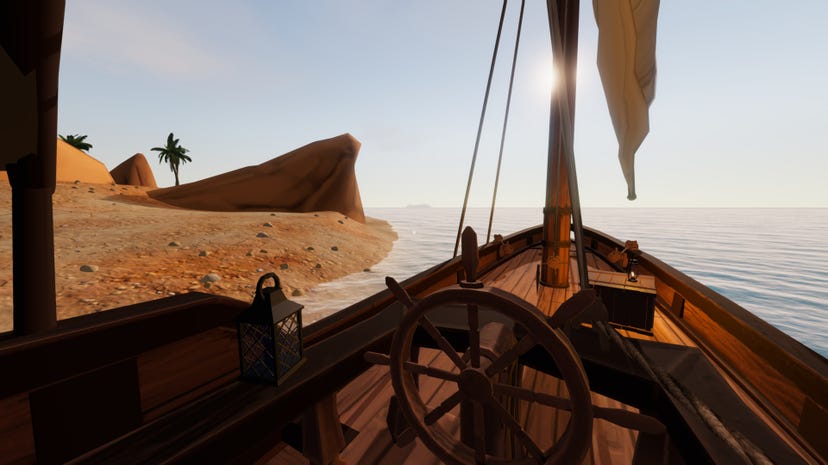
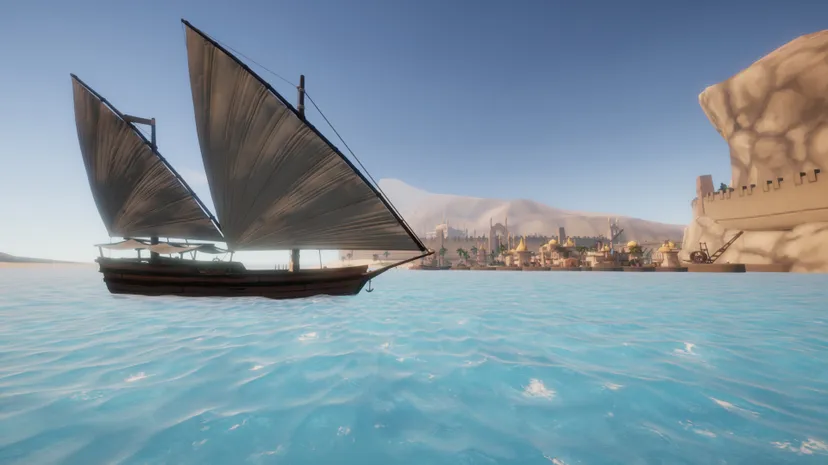
is a physics-based sailing simulator, largely made by one person. Your
character is onboard a boat, and operates it by pulling ropes and
spinning the wheel. There is a map (in your inventory), but it doesn’t
tell your exact location. Instead you have to use other means to
discover where you are and where you’re headed, and it’s up to you to
figure out how to get to your destination.
Sailing isn't only about controlling a ship on the the open seas,
however. Along the way, you are faced with survival and trading elements
that help to create emergent tales of exploration and adventure. Of
course, opposed to those meager trading efforts are the forces of wave
and wind, storm and starvation as meaningful accomplishment can't truly
be felt without a little risk thrown into the mix.
Coming from a background of VR development and immersive experiences, developer Raw Lion Workshop calls Sailwind
their most ambitious project to-date. The dev explores that complexity
in this chat with Game Developer, digging into what brought about this
open-world sailing simulator, its realistic sailing physics, and the
elements of survival, trading, and adventure that define this journey
across the sea.
Game Developer: Sailwind is a full
3D sailing simulation made primarily by one person! How long have you
been going, and what technology do you use to put it together? How do
you handle creating the game's content?
Raw Lion Workshop: It's been close to three years
since I started the project, though only the last two years were full
time work. The game is made in Unity, using the Crest ocean asset for
rendering the ocean and basic boat physics. Most of the other features I
have developed on my own. The models and textures are made in Blender,
and for sound effects I use creative commons and public domain sounds
available online, often heavily edited to fit into the game.
All games that simulate some real-world activity must do so through some degree of representation, but Sailwind
does a good job of exposing players to the details of how sailing
works. Most nautical-themed games take a more game-ish approach to this
subject, while Sailwind almost seems like it wants to teach
players how to actually sail a boat. What caused you to think about
going in this direction with the development, focusing on the kinds of
details that triple-A games would strive to eliminate?
The project started as a simple prototype - I was just having some
fun playing with a realistic sailing physics model. At this stage, I
didn't really consider any game design or player experience aspects. As I
played with my prototype, I realized that it was actually quite fun and
satisfying to handle the sail, watch how it reacts to the wind and how
it affects the boat and its movement, and that's when I decided to build
a full game around it.
It was only after the game was released that I discovered how
challenging this realistic sailing model was for many players. To be
honest, it was quite a big surprise to find out just how much people
struggled with it. After all, I thought, sailing really isn't that
complicated, compared to, say, flying a plane in a flight simulator. If
anything, I was worried the game would be too simple, and I was
considering adding more complexity to the controls to make it more
interesting and engaging. After many complaints about the steep learning
curve (and a relatively high refund rate), I understood why the
triple-A game studios often have to simplify their games so much. Big
studios have to appeal to the widest possible audience in order to make a
good return on their investment, and that means the barrier to entry
for new players has to be as low as possible and the learning curve very
forgiving. Unfortunately, such design generally makes the game less
appealing for those who are looking for a deeper and more challenging
experience.
I'm still trying to find the happy medium between making the game
approachable and pleasant for new players with no sailing experience,
and keeping the complexity, realism, and integrity. There is certainly a
lot of satisfaction to be had when you master the techniques of sailing
and navigation, and the learning and struggles can add to the
experience and make it more meaningful. Games that hold your hand, give
you lots of hints at every step, and pretty much play themselves don't
provide that same sense of accomplishment and satisfaction. However, if
faced with too much challenge at the start, many players will just quit
in frustration.
Sailing is complicated. How does Sailwind go about helping players get their feet wet, so to speak, in learning to operate a boat?
Currently, the tutorial is quite basic - there's a scroll on your
boat which contains text and pictures describing the basics of gameplay
and sailing.
Improving the tutorial is definitely something I'm working on. It's
all about finding the balance between smoothing out the learning curve
to avoid the initial frustration, while still challenging the player to
figure things out and learn by themselves. I've recently added a new
tutorial feature which visually shows you the no go zone when trying to
sail upwind, which is a very important concept when learning to sail.
This new addition was controversial in the community for a good reason -
features like this can diminish the sense of accomplishment and make
the game feel too cheap and easy, so I am very cautious not to move too
far in that direction.
Actually operating and manipulating a boat is just part of
sailing of course. Some other games find it challenging to enable the
player to find his position and get oriented in the world, even with the
use of UI aids, but Sailwind don't use those on purpose! The
possibility of getting lost, as in real life, is another part of the
game. How does a player handle navigation, getting bearings and figuring
out the best direction to head in?
Getting lost is fun! That's often when the real adventure starts, and
it's a great opportunity for emergent challenges and organic stories to
develop. Also, in a game with no enemies or combat of any kind, the
possibility of getting lost adds an element of risk and challenge. The
risk of failure is what makes success meaningful, and it's one of the
necessary elements of any game.
In Sailwind, there are many ways to navigate, and you'll
have to choose between them depending on your current situation. There
is of course the compass, but if you accidentally drop it overboard
(which does happen to many players, apparently!), you can also use the
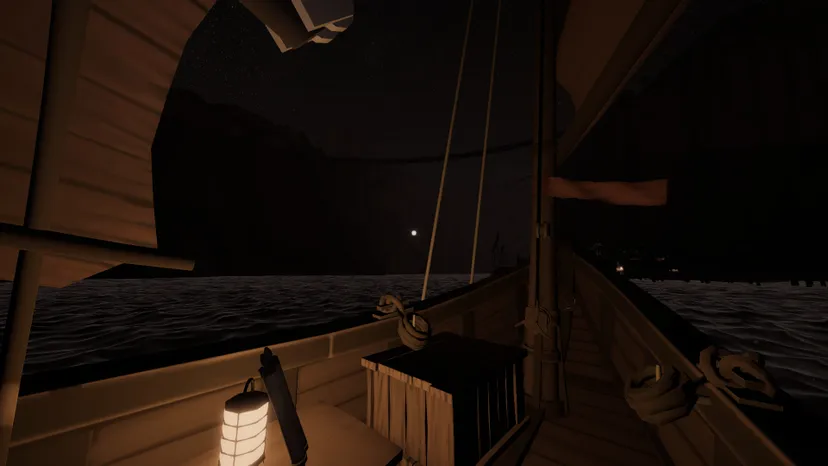
sun, or even the stars in the night sky, to find the cardinal
directions.
There is also the quadrant (a simpler version of the
sextant), which you can use to determine your latitude, and the
chronocompass, a rather complicated tool which uses the sun and its
shadow to find the latitude and longitude. More instruments will be
added later on. Skilled use of these instruments is necessary in order
to successfully complete long ocean voyages (which can take many hours
in real time!).
It's easy to focus just on the sailing and neglect talking
about the non-sailing aspects of the game. There's survival elements,
and a basic trade simulation where the player takes on delivery jobs,
and attempts to complete them for money while keeping his reputation up.
How much of the game do these aspects make up? Are you considering
deeping these elements of play, like, are there plans in the offing to
require that players carry limes to prevent scurvy?
I actually don't consider those features as separate from the sailing
aspect. For me, sailing is more than just controlling a boat. When I
think of sailing, I think of adventure, travel, exploration. I think of
brave men confronting the forces of nature on an epic journey towards
the unknown. Without these aspects, sailing is reduced to just pulling
ropes, turning the wheel, and steering the boat towards no particular
goal. Those things aren't all that fun by themselves, it's exactly that
context of the epic adventure that makes sailing so appealing.
The survival and trading elements in Sailwind serve that
goal, they are there because without them the sailing wouldn't be "real"
in some sense. The need to stock up on food and other supplies adds an
element of risk and strategy, the trading and delivery missions mean you
have a destination, a goal which is a part of a bigger story.
In Sailwind,
you're not just sitting there watching your boat move through the water
- you're on an epic voyage across a vast ocean, battling storms and
overcoming challenges to deliver vital goods to people living in distant
settlements. That's what sailing is really about!
This is also one of the main areas I want to develop further.
Expanding the trading system is a high priority item on the roadmap at
the moment, and there are also plans to expand food and drink systems,
such as introducing the need for balanced nutrition and adding food
spoilage.
One of the interesting design decisions you're made is to
enforce the need to sleep. It's amazing really how many games handwave
sleep away. A one-person vessel on the ocean has unique strategic
requirements. The boat doesn't stay still while the player's character
is unconscious, but continues to travel. What would you say this brings
to the game?
As with most features of Sailwind, I didn't consciously
think about the game design implications of the sleep system. It is
simply something that just... made sense. After all, that's how sleeping
works in the real world! As it turned out, it fits in the game quite
well, but this is more of a happy accident than a planned decision.
First, it adds another layer to the challenge and decision making
aspects, which is pretty important in a relatively simple game like Sailwind.
Second, it gives players an opportunity to take a short break, maybe
stretch a bit, shift their attention away from the game for a moment,
which is probably a healthy thing to do in a long gaming session.
A concession it seems Sailwind must make to physical
reality is the nature of the time scale compared to player's life. 24
game hours cannot equal 24 real hours if the game is to progress at a
reasonable rate. How does Sailwind handle this? Does it make day lengths shorter, distances shorter, or speeds greater than in real life?
Sailwind takes place on a planet which is significantly
smaller than Earth, and the distances and time are scaled down
accordingly, but I've tried to keep this scaling somewhat consistent.
That is, sailing around the globe in the game (not possible currently,
by the way) might take a similar amount of days as it would in the real
world on Earth.
The boats are generally slightly faster than they would be in real
life, but not nearly as much as in most other sailing games. This
slightly faster speed is purely a game design decision - realism is good
and all, but going very slow can often feel frustrating and just not
very fun.
Sailwind is a fascinating game even at this early
stage. Part of what I find personally exciting about it is, it feels
like a simulation of an ancient real-world activity that used to inspire
a whole genre of literature. Sandbox games are kind of like a self-told
storytelling device, a way to have imaginary adventures that can
actually be affected by the player's actions, and Sailwind's
concept is unusually powerful here. But that's just me; why did you
decide to make this, what is it about the idea that pushes you to work
on Sailwind every day?
I think the biggest advantage video games have over other media is
precisely this potential to create dynamic and unique stories. These
stories can be important and meaningful, they're more than just "fun".
For me, it's these stories that can make playing a game a worthwhile
experience, and that's why these are the types of games I'm interested
in. I'm not really into games that try to capture your attention with
highly engaging visuals, instant gratification or cheap rewards. That
type of entertainment feels good in the moment, and can be highly
addictive, but it leaves you drained, tired, and often feeling like
you've just wasted your time doing nothing productive.
On the other
hand, when you create and experience a meaningful story during your
gaming session, it feels fulfilling - the time is not wasted, it was
well spent. That's always my goal when making games. To provide more
than just entertainment. I want the player to feel like they've spent
their time well, and experienced something meaningful.
With ochre-stained streams, crimson-hued beaches and enchanting salt caves, Iran's Hormuz Island is a geologist's Disneyland.
"You
should get a taste of this soil," said Farzad Kay, my tour guide on
southern Iran's Hormuz Island, as we stood at the foot of a ruby-red
mountain that loomed majestically over the shoreline, engulfing the
beach and waves in a crimson shadow. I approached his suggestion with
some trepidation, as I was yet to understand this mysterious,
mineral-laden landscape.
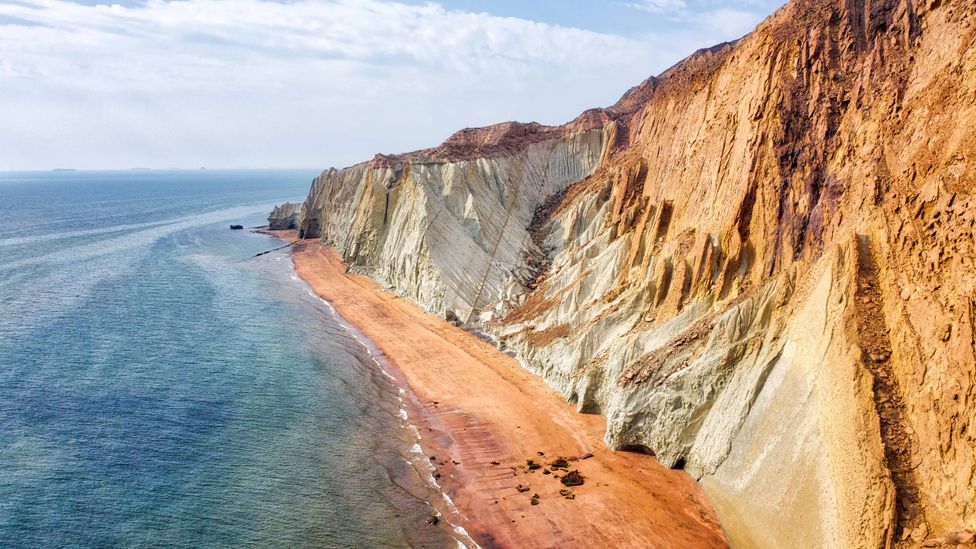
Set 8km off Iran's coast amid the murky blue waters of the Persian Gulf, Hormuz is a teardrop-shaped shimmering salt dome
embedded with layers of shale, clay and iron-rich volcanic rocks that
glow in dazzling shades of red, yellow and orange due to the more than
70 minerals found here. Nearly every inch of Hormuz Island's 42
awe-invoking sq km imparts a story of its formation.
According to Dr Kathryn Goodenough, principal geologist at the
British Geological Survey who has previously worked in Iran, hundreds of
millions of years ago, shallow seas formed thick layers of salt around
the margins of the Persian Gulf. These layers gradually collided and
interlayered with mineral-rich volcanic sediment in the area, causing
the formation of the colourful landmass.
"Over the last 500 million years, the salt layers were buried deeply
by younger layers of volcanic sediment. Since the salt is buoyant, over
time, it has risen through cracks in the overlying rocks to reach the
surface and form salt domes," said Dr Goodenough. She added that these
thick layers of salt, many kilometres below the land, are actually
present across much of the Persian Gulf area.
This geological makeup has resulted in ochre-stained streams,
crimson-hued beaches and enchanting salt caves. In fact, Hormuz is often
called the "rainbow island" because of the spectrum of chromatic hues
that it exudes. It's also home to what's thought to be the only edible
mountain in the world, which Kay was encouraging me to try.
Locals
believe that the salt found at the Goddess of Salt mountain has the
power to release any negative energy (Credit: Saeed Abdolizadeh/Alamy)
The
red soil on the mountain I was standing near, called gelack, is caused
by haematite, an iron oxide thought to be derived from the island's
volcanic rocks. Not only is it a valuable mineral for industrial
purposes, it also plays an important role in local cuisine. Used as a
spice, it lends an earthy flavour to curries and goes perfectly with the
local bread called tomshi, which means "a handful of something".
"The red soil is used as a sauce," explained Maryam Peykani, Farzad's wife. "This sauce is called soorakh
and is spread on flatbread as it is almost cooked. Apart from its
culinary usages, the red soil is also used [in paintings by] local
artists, dyeing, creation of ceramics and cosmetics."
Beyond the ruby-red mountain, there's plenty else to explore on
Hormuz. In the island's west there's a spectacular salt mountain known
as the Goddess of Salt. Extending more than a kilometre, its pale caves
and sharp-edged walls are covered by shimmering salt crystals that look
like the giant columns of a marble palace.
Locals believe that the salt possesses the healing power to soak up
and release any negative energy, and Kay advised me to take my shoes off
so my feet touched the salt dome. "The rock salt is known to release
immense positive energy," he told me. "After having spent [time] in this
valley, you are bound to feel much more invigorated, which is why the
valley is also called the Energy Valley."
Similarly, in the island’s south-west is Rainbow Valley, a stunning
display of multi-hued soil and vividly coloured mountains in shades of
red, purple, yellow, ochre and blue. As I walked, I noticed patches of
bright colours forming geometric patterns that glittered and gleamed as
the sun's rays hit them.
In the nearby Valley of the Statues, rocks were weathered into
fantastical shapes by thousands of years of wind erosion; with a bit of
imagination, I could see birds, dragons and other mythical creatures. It
was like admiring Earth's very own art gallery.
The island glows in shades of red, yellow and orange due to the more than 70 minerals found here (Credit: Lukas Bischoff/Alamy)
Despite
the island’s surreal, kaleidoscopic natural colours, most travellers
don't know about it. According to the Ports and Maritime Organization of
Iran, just 18,000 visitors came here in 2019.
"This natural phenomenon is not fully discovered by world travellers
despite its significant tourist attractions, historically and
naturally," said Ershad Shan, another local, as I sank my teeth into a
spicy, fragrant curry of sardines, red onion, lemon and orange, prepared
using soorakh. "If more attention is paid to the infrastructural
development of Hormuz, this island can be changed to be an important
attraction for tourists."
Locals have started to offer home-cooked meals for tourists and
driving rickshaws and motorcycles to transport people around the island.
"We feel responsible for doing our bit for Hormuz. It's so rare and is a
part of our identity," Shan said. "We feel an urgent need to contribute
towards getting the world to take notice of this eco-heritage."
As I devoured my curry, it struck me that while Hormuz is without
doubt a geologist's Disneyland, it is the edible soil, which is
literally runs through the veins of its inhabitants, that make it truly
special.
Geological Marvels is a BBC Travel series that uncovers the fascinating stories behind natural phenomena and reveals their broader importance to our planet.
--
Join more than three million BBC Travel fans by liking us on Facebook, or follow us on Twitter and Instagram.
If you liked this story, sign up for the weekly bbc.com features newsletter called
"The Essential List". A handpicked selection of stories from BBC
Future, Culture, Worklife and Travel, delivered to your inbox every
Friday.
Storytelling
is as old as video games. Narrative design--the systematic
understanding of how story works in games, and the production expertise
that goes along with it--is still relatively new. While it’s common to
see job ads for ‘narrative designer’ or ‘narrative director’ these days,
this was not the case just a few short years ago.
Similar to where ‘game design’ was in the early-2000s, narrative
design is an old art but a new (or newly understood) job. This means
that, while it has indeed come a long way, there can still be a lot of
confusion surrounding it: what it is, what it isn’t, where it overlaps
with other disciplines, where it doesn’t. There are still a lot of myths
surrounding it. Chances are you’ve heard of some, and may even harbor
them without knowing it.
This can create confusion and false expectations, hurting development
and in some cases even derailing projects. This will be a series
designed to save you from that, by debunking the most common myths of
narrative design in games. First up:
“Narrative Design is just writing.”
Sometimes “narrative design” and “game writing” are used
interchangeably. You may have heard this yourself. Companies are looking
for a “narrative designer/writer” or someone might say “Our narrative
designer is writing the story." While they are certainly related, it is
important to remember these are two entirely different jobs, with
different skillsets and different tools, that need to work in tandem to
achieve a good narrative player experience.
Narrative design is, as the name implies, a type of design, like
level design or systems design. The skillset and toolbox is that of a
designer: helping create and/or leverage existing mechanics, systems,
levels, art, UI, and sound to achieve a desired dramatic experience for
the user.
A game writer creates the actual written content for the game,
typically player-facing (dialogue, descriptions, menu text, etc.) but
also sometimes team-facing (story bibles, character sheets, beat
planning documents, etc.). Sometimes the narrative designer is also the
game writer. Sometimes they are different people. Sometimes there is a
whole team of narrative designers and game writers, each tasked with
different things.
Seems simple enough, so why does confusion about it persist? A lot of
it has to do with the messy history of narrative and writing in video
games, specifically how game narrative has been traditionally siloed in
the development process.
Historically, throughout much of the 80s and 90s, game narrative was equated with cutscenes and dialogue (and by implication not mechanics, systems, art, or UI). While many games--from Zork to Ultima to countless others--defied this assumption with their holistic, integrated approach to narrative, a lot of the language
used to describe such holistic design was yet to develop, leaving many
production teams with a simplistic “game vs. story” dichotomy informing
their process. The rise of cinema-like visuals in the late 90s further
siloed “story” from “game,” encouraging pipelines developed for film
and tv to be dropped wholesale into game production, entrenching the
perception that “writers” are the ones who work with the film people to
create the movie-like bits, while the team making the actual game is off
doing something else.
While a lot of this confusion has been cleared up today, it can still
trip up projects, starting with the hiring process. Teams that
understand the difference between narrative design and writing will have
clear and specific job ads that reflect this, whereas ones that do not
will often use fuzzier, non specific language that conflates the two or
uses them interchangeably. Companies that know what they are doing know
that if you need a writer, you need to hire a writer. If you need a
narrative designer, you need to hire a narrative designer. If you need
both, you need to hire both. And you are upfront and clear about this in
your job ads all the way through your hiring process.
The biggest problem of hiring a ‘narrative designer’ when what you
really expect is a writer is it belies a narrow-minded, outdated
assumption about what narrative is and can be in your game. If you think
narrative design is someone coming in at the end and adding some words
and VO around decisions that have already been made in gameplay, art,
and UI you are missing that holistic approach to game storytelling that
has been at the core of what makes game stories so memorable, endearing,
and--above all--unique to players. Your mechanics, your art,
and your UI could be doing a lot of the “narrative lifting” as it were.
Distributing your storytelling across all aspects of design, not just
dialogue, cut-scenes, lore, etc., makes dramatic game worlds richer,
fuller, and more resonant with audiences.
A good narrative designer will work with other departments to find
out how the UI can express the protagonist’s personality, how a
well-designed room can have the same effect as a page of dialogue, and
how a game mechanic can express a spiritual and emotional conflict, not
just a physical one. And those are just the basics. More advanced forms
can result in truly innovative and time-saving features, like smart bark
systems that ensure lines don’t become repetitive or ambitious
story-generation systems like the one in Shadow of Mordor.
Having a strong interdisciplinary narrative design foundation--which
includes writing as an important part along with everything else--is
what allows you to “level up” your narrative design, so to speak,
achieving true innovation in the space that players will remember. This
is the ultimate value of understanding how all these parts work together
to create the art of narrative design, and what will distinguish your
game as an intelligently crafted and efficient piece of work.
***
Matthew Weise is a narrative
designer and writer whose work bridges the worlds of games and
traditional entertainment with credits including Disney's Fantasia: Music Evolved and The Jury Room
from Oscar-winning director Barry Levinson. Weise is former game design
director of MIT's GAMBIT Game Lab and currently runs narrative design
consultancy Fiction Control.
Get daily news, dev blogs, and stories from Game Developer straight to your inbox
For as long as there have been wars, there have been soldiers refusing to fight in them. The experimental short How to Disappear
examines the history of military desertion via the online war video
game Battlefield V (2018), drawing wry and provocative contrasts between
digital and real-life combat.
Created by the Austrian art collective
Total Refusal, this thoughtful film also asks: what does it mean that
you can’t desert within this computer-generated world?
Unable to abandon
the battlefield or surrender within Battlefield V, Total Refusal
invents new and unusual forms of pacifistic disobedience for their
user-controlled soldiers. Their imaginative tactics walk a thin line
between trolling other players and challenging the frameworks and mores
of this peculiar space.
By putting aside the intended gameplay, the
group explores muddy moral questions of play, patriotism and war in a
society where lines between digital and real environments grow more
blurred by the day.
For more from Total Refusal’s Leonhard Müllner and
Robin Klengel, watch Operation Jane Walk.
When
tech companies first adopted the technique, there was hardly any
science supporting it. Now researchers know when gamelike features
help—and when they hurt.
When you walk
10,000 steps in a day, your Fitbit rewards you with a jiggle and some
virtual fireworks, giving you a reason to pause and smile with pride.
When you practice a foreign language on Duolingo multiple days in a row,
you earn a “streak” and are encouraged to maintain it, giving you an
extra reason to strive for repetition.
When companies, teachers,
coaches, or apps add features such as symbolic rewards, competition,
social connections, or even just fun sounds and colors to make something
feel more like play, they’re relying on “gamification” to enhance an
experience that might otherwise be dull. I’d wager that most of the apps
on your phone use some element of gamification, but we also see
gamification in our workplaces and from our health insurers.
Gamification
first took off more than a decade ago. At the time, there wasn’t much
evidence for its value; the concept just seemed to make sense. Business
consultants promised organizations that gamifying work could more
effectively motivate employees, not by changing their work itself, but
by changing its packaging, and making goal achievement a bit more
exciting as a result (“Yes! I earned a star!”).
Today,
thanks to science, we know a lot more about when gamification really
works, and what its boundaries seem to be. Beyond the gamified apps and
software we use to learn new skills, companies like Amazon and Uber
now deploy it to boost worker productivity. But to get the results we
seek, in our own lives and in the workplace, it’s important to
understand when gamification will work—and when it will only make
matters worse.
In 2012, Jana
Gallus, a brilliant young economist studying for her doctorate at the
University of Zurich, learned of a problem plaguing Wikipedia—and saw an
opportunity to run an early test of the value of gamification. Despite
the popularity of the 50-million-entry online encyclopedia available in
over 280 languages, Gallus discovered that its top performing editors
were leaving in droves.
And since the so-called Wikipedians who keep the
site’s articles on everything from Game of Thrones to quantum
mechanics accurate and up to date don’t get paid a dime, the
organization needed to find a way to keep its top editors engaged with
the sometimes-monotonous task of curating online content without
offering them money.
In the hopes of reducing turnover, Wikipedia let Gallus run an experiment
with 4,000 new volunteer editors. Based on the flip of a coin, she told
some deserving Wikipedia newcomers that they had earned an accolade for
their efforts, and their names were listed as award winners on a
Wikipedia website. They also received either one, two, or three stars,
which appeared next to their username, with more stars allocated to
better performers.
Other newcomers who had contributed equally valuable
content to Wikipedia but came out on the other end of the coin flip got
no symbolic awards (and weren’t told that such awards existed). Gallus
thought the awards would make a monotonous task feel a bit more like a
game by adding an element of fun and praise for a job well done.
She
was right. The volunteers who received recognition for their efforts
were 20 percent more likely to volunteer for Wikipedia again in the
following month and 13 percent more likely than those who earned no
praise to be active on Wikipedia a year later.
Examples
like this one might make gamification seem like a no-brainer: Why
wouldn’t a corporation want to make work more fun? Despite Gallus’
exciting results, more recent research shows that as a top-down strategy
for behavior change, gamification can easily backfire. Two of my
Wharton colleagues—Ethan Mollick and Nancy Rothbard—ran an experiment
that proved just that.
It involved several hundred salespeople who had
the somewhat boring job of reaching out to businesses and convincing
them to offer coupons for discounted products or services that were then
sold on their company’s website (think Groupon). The salespeople earned
commissions for each coupon eventually sold online.
In
an attempt to make this more exciting, Mollick and Rothbard worked with
professional game designers to create a basketball-themed sales game.
Salespeople could earn points by closing deals with customers, with more
points awarded for bigger deals. Sales from warm leads were called
“layups,” while cold calls were dubbed “jump shots.”
Giant screens on
the sales floor displayed the names of top performers and showed
occasional basketball animations like a successful dunk. Regular emails
updated the “players” on who was winning, and when the game was over,
the winner got a bottle of champagne.
Employees
on just one sales floor participated; the rest were left out. My
colleagues then compared the trajectories of salespeople who played the
game with those who didn’t. Though they’d had high hopes, Mollick and
Rothbard were surprised to find that playing the game didn’t improve
sales performance, and it also didn’t improve the way salespeople felt
at work. But digging into their data further revealed a very interesting
pattern.
The researchers had asked everyone in
their game a set of questions: Did people follow the game? Did they
understand the rules? Did they think it was fair? These questions were
designed to measure which salespeople had “entered the magic circle,”
meaning that they agreed to be bound by the game’s rules rather than the
normal rules that ordinarily guide their work. After all, if people
haven’t entered a game mentally, there’s no real point to it.
Sure
enough, the salespeople who felt that the basketball game was a load of
baloney actually felt worse about work after the game was introduced,
and their sales performance declined slightly. The game benefited only
the salespeople who had fully bought into it—they became significantly
more upbeat at work.
My colleagues argue that
their study highlights a common mistake companies make with
gamification: Gamification is unhelpful and can even be harmful
if people feel that their employer is forcing them to participate in
“mandatory fun.” Another issue is that if a game is a dud, it doesn’t do
anyone any good. Gamification can be a miraculous way to boost
engagement with monotonous tasks at work and beyond, or an over-hyped
strategy doomed to fail. What matters most is how the people playing the
game feel about it.
Gamification may have worked so beautifully at Wikipedia in part because
Wikipedians don’t get paid but instead come to the site as volunteers.
And it’s relatively safe to say that volunteers for any organization
want to be there and want to be productive, or else why would they be
volunteering?
Wikipedia editors devote time to the world’s largest
online encyclopedia because they’re intrinsically motivated to help
share knowledge widely, just as volunteers for the Nature Conservancy
want to help the environment. So Wikipedians naturally have the goal
that the site’s awards are designed to reinforce.
At its best, gamification seems to work when it helps people achieve the goals they want to reach anyway by making the process
of goal achievement more exciting. When people fully buy into a game,
the results can be impressive, durably improving volunteers’
productivity, boosting worker morale, and even, as seen in one recent study,
robustly helping families increase their step counts. But gamification
can tank when players don’t buy in.
If a game is mandatory and designed
to encourage people to do something they don’t particularly care to do
(like achieving an outstanding record of attendance at school),
or if it feels manipulative, it can backfire. Amazon seems to
understand this: They’ve kept their gamification program entirely optional so employees who enjoy it can use it, but it isn’t imposed on anyone.
This
latest science suggests it makes lots of sense for apps to continue
gamifying our achievements, so long as they’re promoting goals we’re
intrinsically eager to reach. But when it comes to using gamelike
features to promote change we might not find so appealing, gamification
doesn’t seem to be a workaround for more substantive solutions.
While
not every context is the right one, under certain conditions,
gamification can make pursuing your aspirations feel more like play. And
that is a powerful tool in any personal or professional quest for
change.
WIRED Opinion publishes articles by outside contributors representing a wide range of viewpoints. Read more opinionshere, and see our submission guidelineshere. Submit an op-ed atopinion@wired.com.